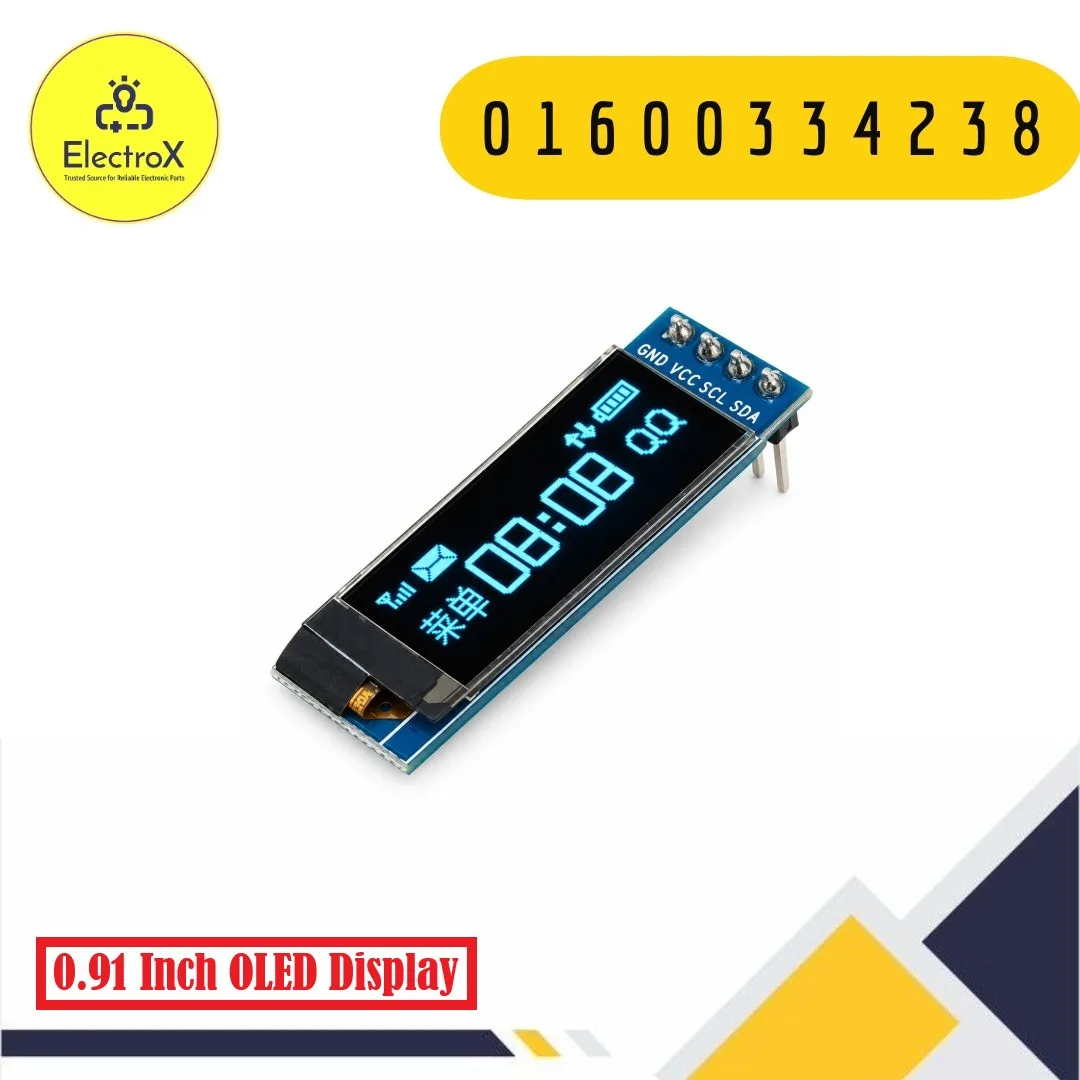
0.91 Inch OLED Display Module 128×32 I2C Blue
৳ 250
- Display Size: 0.91 inch diagonal
- Resolution: 128 × 32 pixels
- Display Color: Blue monochrome
- Interface: I2C (SDA and SCL)
- Driver IC: SSD1306-compatible controller
1 in stock
0.91 Inch OLED Display Price in Bangladesh
The 0.91 Inch OLED Display Module 128×32 I2C Blue is a compact graphical display designed to provide a clear visual interface for electronic projects. Its small size, blue monochrome output, and two-wire communication interface make it suitable for applications where display space and microcontroller pins are limited.
The module offers a resolution of 128 × 32 pixels, allowing it to show text, numbers, symbols, icons, and simple graphical elements. It can be used to display temperature readings, humidity values, voltage measurements, sensor data, device status, menu options, and other information generated by a microcontroller.
Unlike conventional LCD modules that require a backlight, OLED displays use self-emitting pixels. Each illuminated pixel produces its own light, allowing the display to show bright blue characters against a dark background. This design provides strong contrast and makes the screen suitable for compact instruments and small embedded interfaces.
The module commonly uses an SSD1306-compatible display controller and communicates through the I2C interface. I2C requires only two signal lines—SDA for data and SCL for the clock—in addition to power and ground. This helps conserve GPIO pins on Arduino, ESP32, and other compatible development boards.
The typical module includes four connections: VCC, GND, SDA, and SCL. Many versions support 3.3V and 5V power, although the actual voltage compatibility depends on the specific board and its circuitry. The common I2C address is 0x3C, but this should be verified for the particular module.
With its compact dimensions and straightforward interface, the 0.91-inch OLED display is useful for students, hobbyists, engineers, and makers developing electronic prototypes, portable monitoring devices, sensor displays, and small control panels.
What Is an OLED Display?
OLED stands for Organic Light-Emitting Diode. It is a display technology in which individual pixels emit light when electrical current passes through the appropriate organic materials.
Unlike a conventional LCD, which relies on a backlight to illuminate its pixels, an OLED display can illuminate individual pixels directly. Pixels that are switched off appear dark, creating a high-contrast image without a separate backlight.
This characteristic is useful for small electronic displays that need to show text and measurements clearly. OLED modules can also draw relatively little power when only a small portion of the screen is illuminated, although actual consumption depends on brightness, the number of active pixels, and the module design.
The 128×32 format provides 128 horizontal pixels and 32 vertical pixels. This creates a compact rectangular display suitable for short text lines, status messages, and small graphics.
Key Features
1. Compact 0.91-Inch Display
The small screen fits into projects with limited mounting space. Its compact format is suitable for handheld instruments, small enclosures, and embedded electronics.
2. 128×32 Pixel Resolution
The 128 × 32 pixel matrix supports text, numerical readings, symbols, and basic graphics. Developers can arrange information across the available horizontal and vertical space.
3. Blue Monochrome Output
The blue display color provides a distinctive appearance against a black background. It is suitable for simple interfaces where one display color is sufficient.
4. I2C Communication Interface
The I2C interface uses SDA and SCL signal lines, reducing the number of connections needed compared with many parallel display interfaces.
5. SSD1306-Compatible Controller
The module commonly uses an SSD1306-compatible controller supported by widely used embedded display libraries. Confirm the controller and display configuration for your particular version.
6. Self-Illuminating Pixels
OLED pixels emit their own light, so a separate backlight is not required. This supports a thin module design and high contrast between illuminated pixels and the dark background.
7. Four-Pin Connection
The common four-pin arrangement consists of VCC, GND, SDA, and SCL. This makes wiring straightforward for compatible development boards.
8. Supports Text and Basic Graphics
The display can show numbers, letters, symbols, simple diagrams, status indicators, and small icons when programmed with a compatible library.
9. Suitable for Multiple Development Platforms
The module can be integrated into Arduino, ESP32, STM32, and other compatible microcontroller projects. Raspberry Pi projects can also use it through I2C when the electrical interface is suitable.
Technical Specifications
| Parameter | Specification |
|---|---|
| Product Name | 0.91 Inch OLED Display Module 128×32 I2C Blue |
| Display Technology | OLED |
| Diagonal Size | 0.91 inch |
| Resolution | 128 × 32 pixels |
| Display Type | Monochrome graphic display |
| Pixel Color | Blue |
| Background | Black |
| Driver IC | SSD1306 or compatible |
| Communication Interface | I2C / IIC |
| Signal Pins | SDA, SCL |
| Power Pins | VCC, GND |
| Typical Operating Voltage | 3.3V–5V on compatible versions |
| Common I2C Address | 0x3C, subject to module configuration |
| Typical Module Dimensions | Approximately 38 × 12 mm; varies by version |
| Backlight | Not required |
| Display Content | Text, numbers, symbols, and simple graphics |
| Compatible Platforms | Arduino, ESP32, STM32, Raspberry Pi and other compatible systems |
| Typical Applications | Sensor readouts, portable instruments, status displays, and embedded interfaces |
Technical note: Dimensions, I2C address, controller variant, and voltage compatibility may vary among manufacturers. Confirm the actual module before treating these details as guaranteed specifications.
Working Principle
The OLED display receives commands and image data from a host microcontroller through the I2C interface. The controller communicates with the display driver, which manages the pixels and determines which areas of the screen should illuminate.
First, the display receives power through VCC and GND. The SDA and SCL lines connect it to the microcontroller’s I2C bus. Compatible software initializes the display controller and configures the display’s operating mode.
The microcontroller then sends commands and graphical data to the display. This data represents the pixels that should be illuminated to form characters, numbers, symbols, or other graphical elements. The controller stores and manages the display data and updates the pixel matrix accordingly.
For example, a temperature-monitoring project can read a temperature sensor and send the measured value to the OLED. The display library converts the value into a visual representation and updates the screen so that the measurement can be viewed by the user.
Because the display uses OLED technology, individual pixels emit light directly rather than relying on a backlight. Pixels that are not illuminated remain dark, providing contrast between the displayed information and the background.
The I2C interface helps simplify wiring, but the microcontroller still needs suitable software to initialize the display and render its contents. The display itself does not measure temperature, voltage, humidity, or other physical parameters; those values must come from connected sensors or measurement circuits.
Applications
Arduino Projects
Use the display with compatible Arduino boards to show sensor measurements, menu options, counters, and device status.
ESP32-Based Systems
The OLED can provide a compact user interface for ESP32 projects involving wireless monitoring, IoT devices, automation, and sensor data.
Temperature and Humidity Monitoring
Display measurements collected from compatible environmental sensors. The screen can show numerical values and short status messages.
Voltage and Battery Monitoring
In a suitable measurement circuit, the display can present measured voltage, battery status, or other calculated values.
Portable Electronic Instruments
The compact screen is useful for handheld testers, measurement devices, and small electronic instruments that need a simple display.
Robotics Projects
Robotic systems can use the display to show operating modes, sensor readings, battery information, or diagnostic messages.
IoT Devices
Connected devices can display local status information, network indicators, sensor readings, and other short messages without requiring a larger screen.
Digital Clocks and Counters
The display can show time, counts, elapsed values, or other numerical information supplied by the controller.
Educational Electronics Projects
Students can use the module to learn I2C communication, display libraries, graphical output, and microcontroller interfacing.
Advantages
- Small form factor suitable for compact electronic devices.
- 128 × 32 pixel resolution for text and simple graphics.
- Blue-on-black monochrome appearance.
- No separate backlight required.
- I2C communication helps conserve GPIO pins.
- Four-pin interface simplifies wiring.
- Compatible with many common microcontroller platforms.
- Useful for real-time measurements and device-status information.
Limitations
The display has only 128 × 32 pixels, so it cannot show as much information as a larger or higher-resolution screen. Complex graphics, long text, and detailed images must be simplified.
The display is monochrome blue and does not provide full-colour output. It also requires compatible software to initialize the controller and render content.
I2C communication depends on correct wiring, appropriate logic levels, and a compatible address. A module that supports 5V power does not necessarily make every signal pin 5V tolerant, so the board’s specifications should be checked before connection.
OLED pixels can also degrade over time, particularly when the same bright elements remain illuminated continuously. Using appropriate brightness settings and varying the displayed content can help reduce unnecessary pixel stress.
Installation and Usage Tips
- Check the module’s VCC and GND labels before applying power.
- Connect SDA and SCL to the controller’s corresponding I2C pins.
- Verify voltage and logic-level compatibility, especially with 3.3V controllers.
- Confirm the I2C address using the product documentation or an I2C scanner.
- Use a compatible display library and the correct 128×32 screen configuration.
- If the display remains blank, check power, wiring, address, controller configuration, and library settings.
- Keep the module protected from mechanical damage and moisture.
- Avoid leaving fixed bright graphics on the screen for unnecessarily long periods.
Why Choose the 0.91 Inch OLED Display Module?
The 0.91 Inch OLED Display Module 128×32 I2C Blue is a practical choice for projects that need a compact screen without the wiring complexity of a larger parallel-interface display. Its high-contrast monochrome output and common I2C interface make it suitable for showing measurements, status messages, and basic graphical information.
Whether you are building a sensor monitor, a portable electronic instrument, a robotics project, or an IoT device, this display can provide a compact visual interface when paired with a compatible controller and suitable software.
Why Buy from ElectroXBD?
ElectroXBD supplies electronic components, display modules, sensors, development boards, and accessories for students, hobbyists, makers, laboratories, and engineering projects in Bangladesh.
Whether you are developing an Arduino project, building an ESP32-based device, or assembling an embedded electronics prototype, ElectroXBD helps you source components for your project requirements.
Business Address: H#1/1, Opposite of RH Chhatrabash, Vodra-Talaimari Road, Rajshahi, Bangladesh.
Website: electroxbd.com
Contact / WhatsApp: 01600334238
Email: electroxbd@gmail.com
Frequently Asked Questions (FAQ)
1. What is a 0.91 Inch OLED Display Module 128×32?
It is a compact monochrome OLED screen with 128 × 32 pixel resolution, designed to display text, numbers, symbols, and simple graphics in electronic projects.
2. Which controller does this OLED display use?
Many versions use the SSD1306 display controller or a compatible variant. Check the specific module documentation to confirm the controller.
3. What is the operating voltage?
Many common modules support 3.3V–5V input, but the exact voltage range depends on the board design. Verify the supplied module’s specifications.
4. Which interface does this display use?
This version uses I2C communication through SDA and SCL, with separate VCC and GND connections.
5. What is the typical I2C address?
The common address is 0x3C, although some modules may use a different address. An I2C scanner can help identify the address.
6. Can I use this display with Arduino?
Yes. It can be used with compatible Arduino boards through the I2C interface and a suitable OLED library.
7. Is the display compatible with ESP32?
Yes, provided the module’s supply voltage and I2C logic levels are compatible with the ESP32.
8. Can it display sensor readings?
Yes. A compatible microcontroller can read data from sensors and send text or numerical values to the OLED.
9. Does the OLED require a backlight?
No. OLED pixels emit their own light, so the display does not require a separate backlight.
10. Where can I buy a 0.91 Inch OLED Display Module in Bangladesh?
You can buy the 0.91 Inch OLED Display Module 128×32 I2C Blue from ElectroXBD, a trusted electronics components supplier in Bangladesh. Visit electroxbd.com or contact 01600334238 for availability.
Common Questions:
Q: What is the price of 0.91 Inch OLED Display Module 128×32 I2C Blue in Bangladesh?
A: The latest price of 0.91 Inch OLED Display Module 128×32 I2C Blue in Bangladesh is 250 BDT.
Q: Where to buy 0.91 Inch OLED Display Module 128×32 I2C Blue in Bangladesh?
A: You can buy the 0.91 Inch OLED Display Module 128×32 I2C Blue at the best price from ElectroXBD in Bangladesh.
Only logged in customers who have purchased this product may leave a review.
FAQs
Related products
-
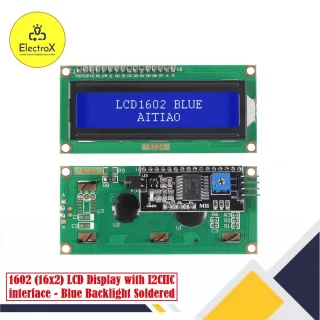
LCD1602 Display with I2C Module Soldered
Original price was: ৳ 300.৳ 250Current price is: ৳ 250.Add to cart-
Display Type: 16×2 character LCD
-
Interface: I2C serial communication
-
Operating Voltage: 5V DC
-
Backlight: LED backlight for clear visibility
-
Compatibility: Works with Arduino, Raspberry Pi, and other microcontrollers
-


Reviews
There are no reviews yet.