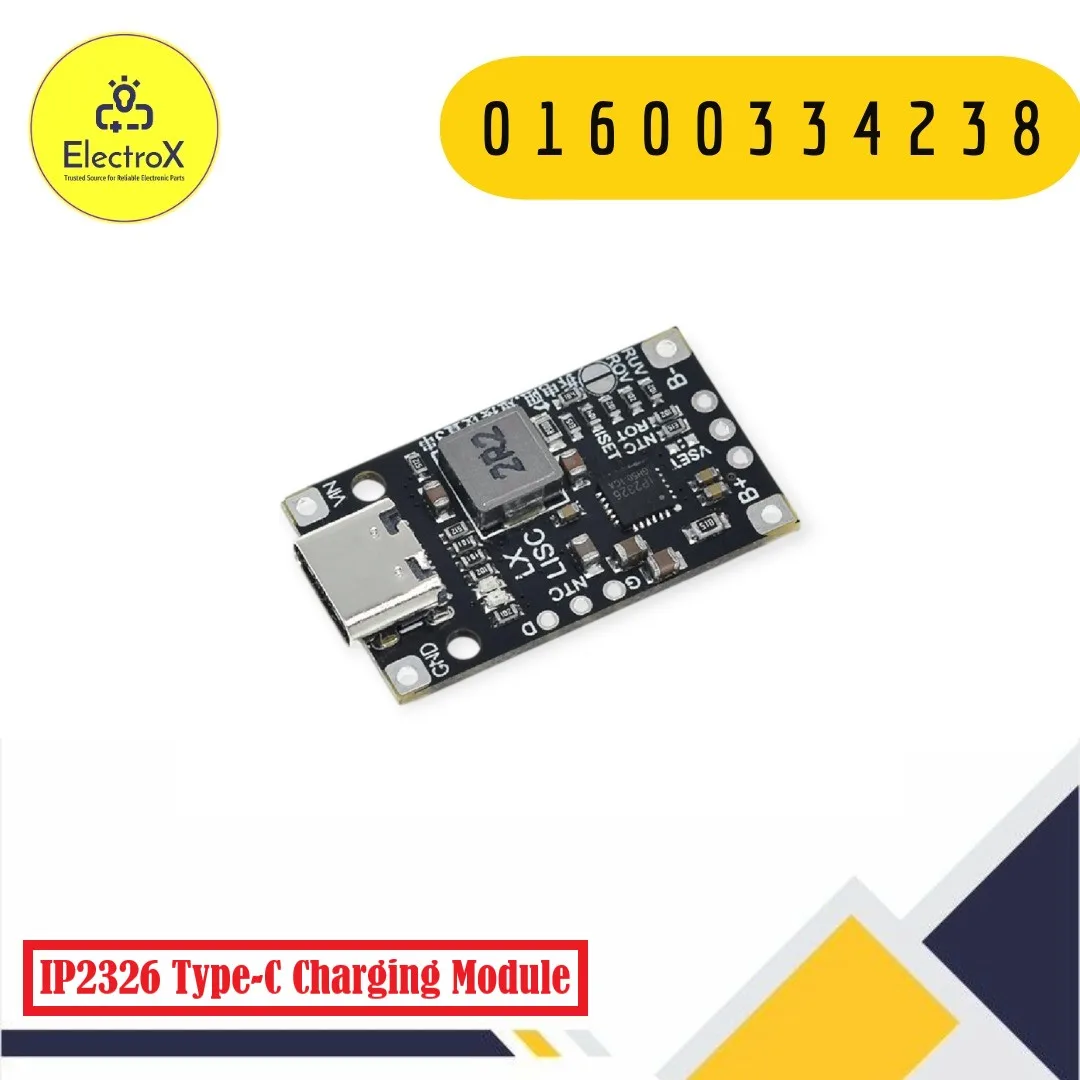
IP2326 Type-C Lithium Battery Charging Module
৳ 100
- IC: IP2326
- Input: USB Type-C
- Battery Support: 2S / 3S Li-ion
- Charging Voltage: 8.4V / 12.6V
- Charging Current: Up to approximately 1.5A
IP2326 Type-C Lithium Battery Charging Module Price in Bangladesh
The IP2326 Type-C Lithium Battery Charging Module is a compact boost charging board designed to charge compatible 2S and 3S lithium-ion battery packs using a USB Type-C input. It is particularly useful for DIY electronics, rechargeable battery projects, portable equipment, robotics, and custom battery-powered products where a conventional single-cell charging module is not sufficient.
The module is based on the IP2326 charging IC, which supports constant-current/constant-voltage charging and is designed for two- or three-series lithium battery configurations. The IC can boost a lower USB input voltage to the voltage required for charging a multi-cell lithium battery pack.
For a standard lithium-ion configuration, a 2S pack has approximately 7.4V nominal voltage and requires approximately 8.4V for full charging. A 3S pack has approximately 11.1V nominal voltage and requires approximately 12.6V for full charging. The IP2326 can be configured for these charging voltages.
One of the main advantages of this module is its USB Type-C input. Instead of requiring a dedicated higher-voltage DC adapter, the module can use a suitable USB power source and boost the input to the required battery charging voltage. Depending on the implementation and power source, IP2326-based boards can support fast-charging protocols and boost charging around the 15W class.
The charging current can be configured through external components on IP2326 implementations. The IC documentation describes adjustable charging-current settings, while commonly sold modules are configured around 1.2A–1.5A depending on the board version.
Some IP2326 module versions also include cell balancing for 2S packs, LED charging indicators, input protection, output overcurrent protection, overvoltage protection, short-circuit protection, thermal protection, and charging timeout functions. However, features vary between board designs, so the exact PCB should be checked before relying on a particular function.
A particularly important distinction is that not every IP2326 implementation has the same balancing functionality. The IP2326 IC supports different configurations, and some reference designs may be configured without balancing. Therefore, users should verify whether the specific module being purchased includes the advertised balancing circuit.
This module is intended for standard 3.7V-per-cell lithium-ion/lithium-polymer chemistry, with approximately 4.2V full-charge voltage per cell. It should not be assumed to be compatible with LiFePO4 batteries, which have different voltage characteristics and require an appropriate charging profile.
The IP2326 module is therefore a useful solution for designers who want to charge a multi-cell Li-ion battery pack from a convenient Type-C power source while keeping the charging electronics compact.
What is the IP2326?
IP2326 is a lithium-battery charging power-management IC designed for 2-series and 3-series lithium battery charging. It uses a boost topology to raise the input voltage to the level required by the battery pack and implements CC/CV charging.
The typical charging targets are:
- 2S Li-ion: 8.4V
- 3S Li-ion: 12.6V
The exact operating range and configuration depend on the implementation and external components.
Key Features
- IP 2326 lithium battery charging IC
- USB Type-C input
- Supports compatible 2S and 3S Li-ion configurations
- Boost charging architecture
- 8.4V charging output for 2S
- 12.6V charging output for 3S
- Charging current configurable through external components
- Approximately 1.5A class charging on common module versions
- Up to approximately 15W on commonly sold modules
- CC/CV charging control
- LED charging-status indication on applicable versions
- Protection features on applicable board versions
- Compact PCB design
- Useful for 18650 and Li-Po battery packs
- Suitable for portable electronics and DIY projects
Technical Specifications
- Product Type: Lithium Battery Charging Module
- IC: IP2326
- Input Interface: USB Type-C
- Battery Chemistry: Standard Li-ion / Li-Po
- Battery Configuration: 2S / 3S
- 2S Charging Voltage: 8.4V
- 3S Charging Voltage: 12.6V
- Charging Current: Configurable; common modules are around 1.2A–1.5A
- Maximum Power: Approximately 15W on common module versions
- Charging Method: CC/CV
- Balancing: Available on certain 2S module implementations
- Protection: Depends on board implementation
- Application: Rechargeable multi-cell lithium battery packs
Important: IP 2326 modules are available in different PCB configurations. Input fast-charging support, charging current, balancing, protection functions, and exact dimensions may vary. Verify the exact board specification before designing a battery product around it.
Working Principle
The IP 2326 module converts the incoming USB power into the appropriate voltage required by the connected lithium battery pack.
For a 2S battery, the charging voltage is approximately 8.4V.
For a 3S battery, the charging voltage is approximately 12.6V.
The charging process uses constant-current (CC) and constant-voltage (CV) stages. The IP2326 documentation describes reduced charging current during low battery voltage conditions before moving into the configured charging-current range, followed by constant-voltage operation as the battery approaches its full-charge voltage.
This approach allows the module to charge the battery in a controlled manner rather than simply applying a fixed voltage to the battery.
2S and 3S Battery Compatibility
2S Li-ion
A typical 2S Li-ion pack has:
- Nominal voltage: 7.4V
- Full-charge voltage: 8.4V
The IP2326 can be configured to charge this battery to the appropriate voltage.
3S Li-ion
A typical 3S Li-ion pack has:
- Nominal voltage: 11.1V
- Full-charge voltage: 12.6V
The IP 2326 can also be configured for this charging voltage.
Applications
The IP 2326 Type-C Lithium Battery Charging Module can be used for:
- 2S 18650 battery packs
- 3S 18650 battery packs
- 2S Li-Po battery packs
- 3S Li-Po battery packs
- DIY power banks
- Portable electronics
- Robotics projects
- RC electronics
- Battery-powered instruments
- IoT devices
- Custom rechargeable products
- DIY power supplies
- Portable lighting systems
- Engineering prototypes
- Educational electronics projects
Advantages
- Convenient USB Type-C input
- Can charge multi-cell Li-ion packs
- Boost architecture allows lower-voltage input sources
- Compact PCB
- CC/CV charging
- Configurable charging current
- Suitable for DIY battery projects
- Useful for 2S and 3S configurations
- Some versions provide balancing functions
- Protection functions are available on applicable implementations
- Suitable for portable designs
Limitations
- Not intended for arbitrary lithium battery chemistries.
- Do not assume compatibility with LiFePO4.
- Exact features vary between IP2326 module versions.
- Charging current depends on the board configuration and input power.
- A USB power source may not always provide sufficient power for the maximum charging rate.
- Some versions may not include cell balancing.
- This is a charging module, not necessarily a complete battery protection system for every application.
- Correct battery configuration is essential.
Installation / Usage Tips
- Confirm whether your battery is 2S or 3S Li-ion/Li-Po before connecting it.
- Make sure the module is configured for the correct series count.
- Verify the battery polarity before connection.
- Use the correct battery terminals on the PCB.
- Use a suitable USB Type-C power source.
- Do not connect a 3S battery to a module configured for 2S.
- Do not use the module with LiFePO4 unless the specific board is explicitly designed for it.
- Confirm the charging current is appropriate for the battery.
- For multi-cell packs, use appropriately matched cells.
- If cell balancing is important, verify that the specific board includes the balancing circuit.
- Do not leave an incorrectly configured battery connected to the charger.
- Inspect the battery and wiring before charging.
IP2326 vs TP4056
The IP2326 and TP4056 serve different battery configurations.
A typical TP4056 module is designed for single-cell 3.7V Li-ion batteries, with a 4.2V charging voltage.
IP2326-based modules can be configured for 2S or 3S lithium battery packs, allowing charging voltages of approximately 8.4V or 12.6V.
Therefore:
| Feature | IP2326 | Typical TP4056 |
|---|---|---|
| Battery configuration | 2S / 3S | 1S |
| Typical full-charge voltage | 8.4V / 12.6V | 4.2V |
| Input | Type-C on common modules | USB / 5V |
| Charging topology | Boost | Linear |
| Multi-cell charging | Yes | No |
| Best suited for | 2S/3S Li-ion | Single-cell Li-ion |
Why Choose IP 2326 Type-C Lithium Battery Charging Module?
The IP2326 Type-C Lithium Battery Charging Module is a convenient choice when you need to charge a 2S or 3S lithium-ion battery pack from a USB Type-C power source.
Its boost architecture makes it particularly useful for portable electronics and DIY battery systems where the available input source is lower than the required battery charging voltage. With configurable charging parameters and compact dimensions, it can be integrated into custom battery-powered products and prototypes.
Why Buy from Electroxbd?
- 100% Quality Tested Products
- Trusted Source for Reliable Electronic Parts
- Fast Delivery Across Bangladesh
- Competitive Pricing
- Quality Battery Charging Modules
- Dedicated Technical Support
- Suitable for DIY Battery Projects
- Ideal for Students, Engineers, Technicians and Makers
- Nationwide Delivery Across Bangladesh
Frequently Asked Questions (FAQ)
What batteries can the IP2326 module charge?
IP2326 modules are designed for compatible 2S and 3S standard Li-ion/Li-Po battery packs. Typical full-charge voltages are 8.4V for 2S and 12.6V for 3S.
Can IP2326 charge a single 18650 battery?
This module is designed for multi-cell 2S/3S configurations, not a standard 1S 18650 battery. A dedicated 1S Li-ion charging module is more appropriate for a single cell.
What is the charging current?
The IP2326 supports configurable charging current. Common modules are configured around 1.2A–1.5A, while the exact value depends on the external components and board version.
Can I use a 5V Type-C power supply?
IP2326-based boost charger designs are intended to accept USB Type-C power and boost it to the required battery charging voltage. The exact input and fast-charging requirements depend on the particular module implementation.
Does IP2326 support battery balancing?
Some commercially available IP2326 boards include a 2S balancing circuit, while other IP2326 implementations may not. Therefore, balancing should be confirmed for the exact PCB version rather than assumed from the IC name alone.
Can I use this module with LiFePO4 batteries?
Do not use a standard IP2326 Li-ion module with LiFePO4 unless the specific board is explicitly designed for LiFePO4. Standard Li-ion charging uses approximately 4.2V per cell, whereas LiFePO4 uses a different charging voltage.
Is IP2326 suitable for a 3S 18650 battery pack?
Yes, provided the module is configured for 3S standard Li-ion and the battery pack and charging current are compatible with the module. A 3S pack typically requires approximately 12.6V for full charging.
Where can I buy the IP2326 Type-C Lithium Battery Charging Module in Bangladesh?
You can buy the IP2326 Type-C Lithium Battery Charging Module from Electroxbd, a trusted supplier of electronic components, battery modules, charging boards, and DIY electronics products in Bangladesh.
Common Questions:
Q: What is the price of IP2326 Type-C Lithium Battery Charging Module in Bangladesh?
A: The latest price of IP2326 Type-C Lithium Battery Charging Module in Bangladesh is 100 BDT.
Q: Where to buy IP2326 Type-C Lithium Battery Charging Module in Bangladesh?
A: You can buy the IP2326 Type-C Lithium Battery Charging Module at the best price from ElectroXBD in Bangladesh.
Only logged in customers who have purchased this product may leave a review.
FAQs
Related products
-
AS608 Fingerprint Sensor for Arduino
Original price was: ৳ 1,500.৳ 1,350Current price is: ৳ 1,350.Add to cart- Operating Voltage: 3.6V to 6V.
- Interface: UART (TTL) with baud rates between 9600 and 115200.
- Fingerprint Capacity: Stores up to 162 fingerprints.
- Recognition Time: Less than 1 second for matching.
- Working Current: 50mA (typical), 120mA (max).
-
L298N Green Motor Driver Module
Original price was: ৳ 350.৳ 250Current price is: ৳ 250.Add to cart- Operating Voltage: 5V to 35V DC.
- Maximum Output Current: 2A per channel (peak 3A).
- Dual H-Bridge: Controls two DC motors or one stepper motor.
- Logic Voltage: 5V.
- Built-in Heat Sink: Enhances thermal performance for extended operation.


-
Servo Motor Tester Module
৳ 150Add to cart- Input Voltage: Servo Motor Tester perates on 4.8V to 6V DC.
- Testing Modes: Supports manual, neutral, and automatic sweep modes.
- Control Knob: Equipped with a rotary knob for manual testing.
- Output Interface: Includes three output connectors to test up to three servos simultaneously.
- Compact Design: Lightweight and portable for easy integration into various projects.


Reviews
There are no reviews yet.