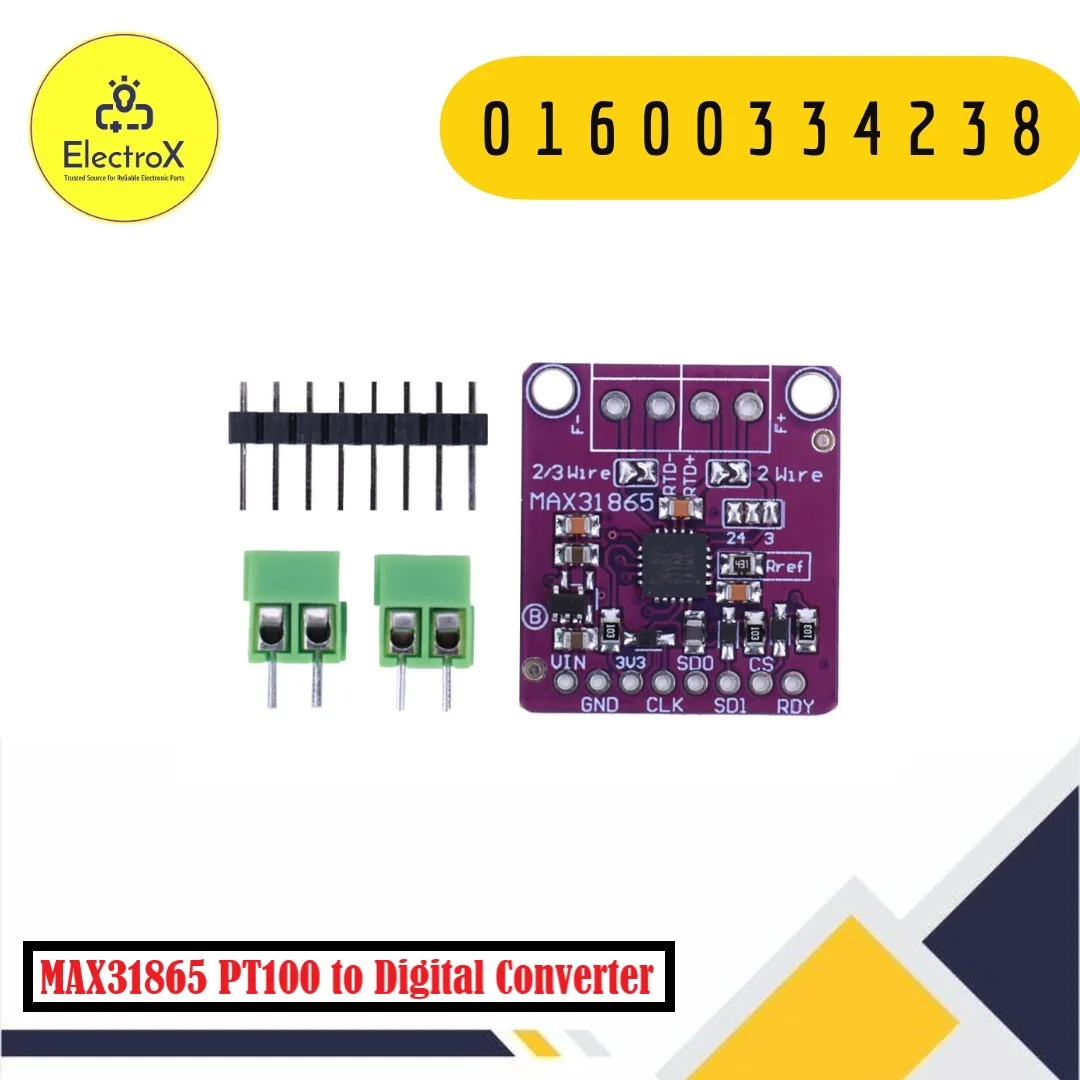
MAX31865 RTD PT100 to Digital Converter Module
৳ 530
- Converter IC: MAX31865 RTD-to-Digital Converter
- Compatible Sensors: PT100 and PT1000 platinum RTDs
- ADC Resolution: 15-bit
- Sensor Connections: 2-wire, 3-wire, and 4-wire
- Communication: SPI interface
MAX31865 RTD PT100 to Digital Converter Module Price in Bangladesh
The MAX31865 RTD PT100 to Digital Converter Module is a precision temperature-sensing interface designed to connect platinum resistance temperature detectors (RTDs) to microcontrollers and embedded electronic systems. It converts the resistance variation of an RTD sensor into digital measurement data that can be processed by Arduino, ESP32, STM32, and other compatible microcontrollers.
Temperature measurement is an essential requirement in industrial automation, laboratory equipment, scientific experiments, food processing, heating systems, and temperature-controlled devices. RTD sensors are widely used in these applications because of their stability, repeatability, and accuracy.
However, an RTD sensor does not directly produce a digital temperature value. Its electrical resistance changes according to temperature, so an appropriate measurement circuit is required to determine the corresponding temperature. The MAX31865 simplifies this process by integrating a precision analogue-to-digital conversion system and RTD measurement circuitry.
The module is based on the MAX31865 IC from Analog Devices (originally Maxim Integrated). It supports platinum RTDs with nominal resistance values from 100Ω to 1kΩ at 0°C, including PT100 and PT1000 sensors.
One of its major advantages is support for 2-wire, 3-wire, and 4-wire RTD connections. This allows users to select an appropriate wiring arrangement depending on sensor installation, cable length, and measurement accuracy requirements.
With its 15-bit ADC, SPI communication, programmable measurement configuration, and integrated fault-detection functions, the MAX31865 is a practical solution for developing digital temperature measurement systems.
What Is an RTD and PT100 Temperature Sensor?
An RTD (Resistance Temperature Detector) is a temperature sensor that measures temperature based on the electrical resistance of a sensing element. Platinum is commonly used because of its stable resistance-temperature characteristics and good long-term repeatability.
A PT100 is a platinum RTD with a nominal resistance of 100Ω at 0°C. As temperature increases, its resistance increases; as temperature decreases, its resistance decreases.
A PT1000 works according to the same principle but has a nominal resistance of 1000Ω at 0°C.
The MAX31865 measures the resistance of these sensors and converts it into digital data. Software can then calculate the corresponding temperature using the appropriate RTD resistance-temperature relationship.
Key Features
1. Compatible with PT100 and PT1000 Sensors
The MAX31865 supports platinum RTD sensors with nominal resistance values ranging from 100Ω to 1kΩ at 0°C. This includes the widely used PT100 and PT1000 temperature sensors.
The appropriate reference resistor and module configuration must match the selected RTD type. A board designed for PT100 should not automatically be assumed to support PT1000 without checking its reference resistor and configuration.
2. High-Resolution 15-Bit ADC
The module uses an integrated 15-bit analogue-to-digital converter to measure the ratio between the RTD resistance and the reference resistance.
The nominal temperature resolution is approximately 0.03125°C, although actual temperature measurement accuracy depends on RTD characteristics, reference resistor tolerance, wiring, calibration, and the sensor’s nonlinear resistance-temperature relationship.
3. Supports 2-Wire, 3-Wire, and 4-Wire RTDs
Different RTD wiring arrangements can be used according to the installation requirements.
- 2-wire: Simple wiring for short connections where lead resistance has a limited effect.
- 3-wire: Common in industrial temperature measurement, offering compensation for lead resistance when the lead resistances are suitably matched.
- 4-wire: Provides the best compensation for cable resistance and is useful for precision measurements.
4. SPI Communication Interface
The MAX31865 communicates with a microcontroller through an SPI-compatible interface. This allows the controller to configure the measurement circuit, initiate conversions, and read digital RTD measurement values.
The SPI interface makes the module suitable for Arduino, ESP32, STM32, and other compatible platforms.
5. Integrated Fault Detection
The MAX31865 includes fault-detection features for identifying problems such as an open RTD element, shorted RTD connections, and certain out-of-range input conditions.
This is useful in temperature monitoring systems where sensor wiring problems need to be detected rather than silently producing unreliable readings.
6. High Input Protection
The MAX31865 IC provides input protection against overvoltage conditions up to ±45V according to the manufacturer’s datasheet. This feature helps improve robustness against certain electrical faults.
It does not make the module suitable for direct connection to arbitrary high-voltage sources. Proper sensor wiring and electrical installation remain essential.
7. Precision Reference Resistor
The RTD measurement circuit uses a precision reference resistor to determine the sensor’s resistance. The reference resistor value is selected according to the RTD type.
Typical recommended values are 400Ω for PT100 and 4kΩ for PT1000. Some commercial breakout boards use 430Ω and 4.3kΩ respectively, so the actual board’s resistor value should be checked.
8. Digital Temperature Measurement
Instead of requiring users to design a complete RTD measurement circuit, the module handles resistance measurement and digital conversion. A microcontroller can process the resulting data and calculate temperature using a suitable library.
9. Suitable for Industrial and Laboratory Applications
The MAX31865 is useful for developing temperature monitoring systems where stable RTD measurement is required, including instrumentation, laboratory equipment, heating control, and industrial automation prototypes.
Technical Specifications
| Parameter | Specification |
|---|---|
| Product Name | MAX31865 RTD PT100 to Digital Converter Module |
| Main IC | MAX31865 |
| Manufacturer | Analog Devices / Maxim Integrated |
| Converter Type | RTD-to-Digital Converter |
| Compatible RTDs | PT100 and PT1000 |
| RTD Resistance Range | 100Ω to 1kΩ at 0°C |
| ADC Resolution | 15-bit |
| Nominal Temperature Resolution | 0.03125°C |
| RTD Wiring | 2-wire, 3-wire, and 4-wire |
| Communication | SPI-compatible |
| Maximum Conversion Time | 21ms |
| Maximum Total Accuracy | 0.5°C over specified operating conditions |
| Fault Detection | Open and short RTD fault detection |
| Input Protection | ±45V (IC specification) |
| Applications | Industrial and precision temperature measurement |
Note: The above specifications describe the MAX31865 IC. Actual breakout-board voltage input, logic-level compatibility, reference resistor, connector layout, and supported RTD configuration depend on the particular board version.
Working Principle
The MAX31865 measures temperature by determining the electrical resistance of a connected platinum RTD sensor.
A platinum RTD changes its resistance according to temperature. For example, a standard PT100 sensor has a resistance of approximately 100Ω at 0°C. As its temperature increases, its resistance increases in a predictable manner.
The MAX31865 uses an external precision reference resistor and an internal measurement circuit to determine the ratio between the RTD resistance and the reference resistance.
The sensor’s resistance is measured using a controlled excitation current. The voltage developed across the RTD is compared with the reference voltage, and the internal delta-sigma ADC converts the measurement into a digital value.
The microcontroller reads this digital value through SPI communication. Software then converts the measured resistance into temperature using the appropriate platinum RTD resistance-temperature equation, such as the Callendar–Van Dusen equation.
The module also supports fault detection, allowing the system to identify certain wiring and sensor problems.
This approach provides a practical method for obtaining digital temperature measurements from platinum RTD sensors without designing a complete analogue measurement circuit.
Understanding 2-Wire, 3-Wire, and 4-Wire RTD Connections
Choosing the correct RTD wiring arrangement is important for achieving reliable temperature measurements.
2-Wire RTD Connection
A 2-wire RTD uses two conductors to connect the sensor to the measurement circuit. It is the simplest wiring arrangement and is suitable for short cable connections or applications where moderate measurement accuracy is acceptable.
However, the resistance of the connecting wires adds to the measured RTD resistance. This can introduce temperature measurement errors, particularly when using a PT100 sensor with long cables.
3-Wire RTD Connection
A 3-wire RTD uses three conductors and is widely used in industrial temperature measurement systems.
The MAX31865 can compensate for lead resistance when the relevant wire resistances are suitably matched. This makes the 3-wire arrangement a practical balance between wiring cost and measurement accuracy.
4-Wire RTD Connection
A 4-wire RTD uses separate current-carrying and voltage-sensing conductors. This arrangement minimises the effect of cable resistance on the measurement.
It is particularly useful for precision temperature measurement and installations where cable resistance could otherwise introduce significant errors.
Applications
1. Industrial Temperature Monitoring
The MAX31865 can be used with PT100 or PT1000 sensors to monitor temperatures in industrial equipment, production processes, and temperature-controlled systems.
2. Arduino Temperature Measurement Projects
Students and hobbyists can connect a PT100 sensor to an Arduino through the MAX31865 module. Temperature readings can be displayed on an LCD or OLED screen and used to control other electronic devices.
3. ESP32-Based Temperature Monitoring
The module can communicate with ESP32 development boards through SPI. Developers can create Wi-Fi-enabled temperature monitoring systems, data loggers, and remote monitoring prototypes.
4. Laboratory Instruments
The combination of RTD measurement and digital conversion makes the module useful for laboratory experiments, scientific instrumentation, and educational measurement systems.
5. Heating and Cooling Control
Temperature data from the MAX31865 can be used in microcontroller-based heating and cooling systems. A controller can operate relays, heaters, or cooling devices according to programmed temperature limits.
6. Food Processing and Storage
PT100 sensors are commonly used in temperature monitoring applications involving food processing, storage equipment, and controlled heating environments.
7. Industrial Automation
The module can support temperature monitoring prototypes for industrial machinery, process control systems, and embedded automation equipment.
8. Scientific Research Projects
Researchers and engineering students can use the MAX31865 to develop accurate RTD-based temperature measurement systems and study resistance-temperature characteristics.
Advantages
- Supports both PT100 and PT1000 platinum RTD sensors.
- Compatible with 2-wire, 3-wire, and 4-wire configurations.
- Provides 15-bit digital conversion.
- Uses a simple SPI communication interface.
- Includes integrated RTD fault-detection features.
- Reduces the need for designing a separate RTD measurement circuit.
- Suitable for Arduino, ESP32, and other SPI-compatible microcontrollers.
- Useful for industrial, laboratory, and research temperature monitoring.
- Supports precision measurement when paired with a suitable RTD and properly configured circuit.
Limitations and Important Considerations
- The module requires a compatible platinum RTD sensor; it is not a standalone temperature sensor.
- The reference resistor must match the selected RTD configuration.
- Cable resistance can introduce errors, particularly with 2-wire PT100 connections.
- Accurate measurements depend on sensor quality, calibration, reference resistor tolerance, and wiring.
- SPI communication is required; it does not use I2C.
- The nominal 0.03125°C resolution should not be confused with guaranteed measurement accuracy.
- Breakout-board voltage compatibility varies. The bare MAX31865 IC is a low-voltage device.
- Correct temperature calculation requires an appropriate RTD resistance-temperature conversion method.
Installation and Usage Tips
- Select a compatible PT100 or PT1000 platinum RTD sensor.
- Check the reference resistor fitted to the MAX31865 board.
- Confirm that the board is configured for the selected RTD type.
- Select the appropriate 2-wire, 3-wire, or 4-wire connection arrangement.
- Connect the RTD sensor to the correct terminal positions.
- Connect the module’s power and ground according to its board specification.
- Connect the SPI pins to the microcontroller.
- Configure the SPI chip-select pin and install a compatible MAX31865 software library.
- Select the correct RTD type and wiring configuration in the program.
- Read the resistance or temperature data and check for sensor faults.
- Compare the readings with a reliable reference thermometer during initial testing.
- Use suitable wiring and shielding in electrically noisy environments.
For Arduino projects, the Adafruit MAX31865 library is a commonly used option. It supports configuration for PT100 and PT1000 sensors and different RTD wiring arrangements.
Why Choose the MAX31865 RTD PT100 to Digital Converter Module?
The MAX31865 is a practical solution for projects that require digital temperature measurement using platinum RTD sensors. Its integrated conversion circuitry, multiple wiring options, SPI interface, and fault-detection features make it suitable for a broad range of temperature-monitoring applications.
Whether you are developing an industrial temperature monitoring system, building a laboratory instrument, or experimenting with Arduino-based temperature measurement, this module simplifies the process of interfacing PT100 and PT1000 sensors with digital electronics.
Why Buy from ElectroXBD?
ElectroXBD supplies electronic components, sensors, development boards, robotics accessories, and project materials for students, engineers, researchers, technicians, and electronics enthusiasts in Bangladesh.
Whether you are developing an industrial automation prototype, building a temperature monitoring device, or working on a university research project, ElectroXBD aims to provide useful electronic components for your work.
Business: ElectroXBD
Website: https://electroxbd.com
Contact / WhatsApp: 01600334238
Email: electroxbd@gmail.com
Shop Address: H#1/1, Opposite of RH Chhatrabash, Vodra-Talaimari Road, Rajshahi, Bangladesh.
Frequently Asked Questions (FAQ)
1. What is the MAX31865 RTD PT100 to Digital Converter Module used for?
It is used to interface PT100 and PT1000 platinum RTD temperature sensors with microcontrollers. It measures RTD resistance and converts the result into digital data for temperature calculation.
2. Is the MAX31865 compatible with PT100 sensors?
Yes. The MAX31865 supports PT100 sensors with a nominal resistance of 100Ω at 0°C. The board’s reference resistor and configuration must be suitable for PT100 operation.
3. Can I use the MAX31865 with PT1000 sensors?
Yes. The MAX31865 IC supports PT1000 sensors, but the breakout board must have the appropriate reference resistor and configuration for PT1000 measurement.
4. Does the MAX31865 support 3-wire PT100 sensors?
Yes. It supports 2-wire, 3-wire, and 4-wire RTD configurations. Three-wire connections are commonly used in industrial temperature measurement.
5. Can I connect the MAX31865 to Arduino?
Yes. The module can connect to compatible Arduino boards through SPI communication. A suitable software library can be used to read RTD temperature measurements.
6. Is the MAX31865 compatible with ESP32?
Yes. ESP32 supports SPI communication and can interface with the MAX31865 module for digital temperature measurement.
7. What is the ADC resolution of the MAX31865?
The MAX31865 uses a 15-bit ADC. Its nominal temperature resolution is approximately 0.03125°C, although actual measurement accuracy depends on the complete sensor system.
8. What is the difference between a PT100 and a PT1000 sensor?
A PT100 has a nominal resistance of 100Ω at 0°C, while a PT1000 has a nominal resistance of 1000Ω at 0°C. Both are platinum RTD temperature sensors.
9. Does the MAX31865 use I2C or SPI communication?
The MAX31865 uses an SPI-compatible interface. It does not communicate through I2C.
10. Where can I buy the MAX31865 RTD PT100 to Digital Converter Module in Bangladesh?
You can buy the MAX31865 RTD PT100 to Digital Converter Module from ElectroXBD, a trusted electronics components supplier in Bangladesh.
Common Questions:
Q: What is the price of MAX31865 RTD PT100 to Digital Converter Module in Bangladesh?
A: The latest price of MAX31865 RTD PT100 to Digital Converter Module in Bangladesh is 530 BDT.
Q: Where to buy MAX31865 RTD PT100 to Digital Converter Module in Bangladesh?
A: You can buy the MAX31865 RTD PT100 to Digital Converter Module at the best price from ElectroXBD in Bangladesh.
FAQs
Related products
-
Servo Motor Tester Module
৳ 150Add to cart- Input Voltage: Servo Motor Tester perates on 4.8V to 6V DC.
- Testing Modes: Supports manual, neutral, and automatic sweep modes.
- Control Knob: Equipped with a rotary knob for manual testing.
- Output Interface: Includes three output connectors to test up to three servos simultaneously.
- Compact Design: Lightweight and portable for easy integration into various projects.
-
L298N Red Motor Driver Module
Original price was: ৳ 180.৳ 160Current price is: ৳ 160.Add to cart- Operating Voltage: 5V to 35V DC.
- Output Current: 2A per channel (peak 3A per channel).
- Dual H-Bridge: Controls two DC motors or one stepper motor.
- Logic Voltage: 5V.
- Heat Sink: Includes an onboard heat sink for thermal management.
-
AS10 Photocell Light Dependent Switch
Original price was: ৳ 220.৳ 190Current price is: ৳ 190.Add to cart- Operating Voltage: AC 220V–240V
- Sensor Type: Photocell (Light Dependent)
- Control Mode: Automatic Day/Night Switching
- Installation: Outdoor Wall/Pole Mount
- Application: Automatic Lighting Control