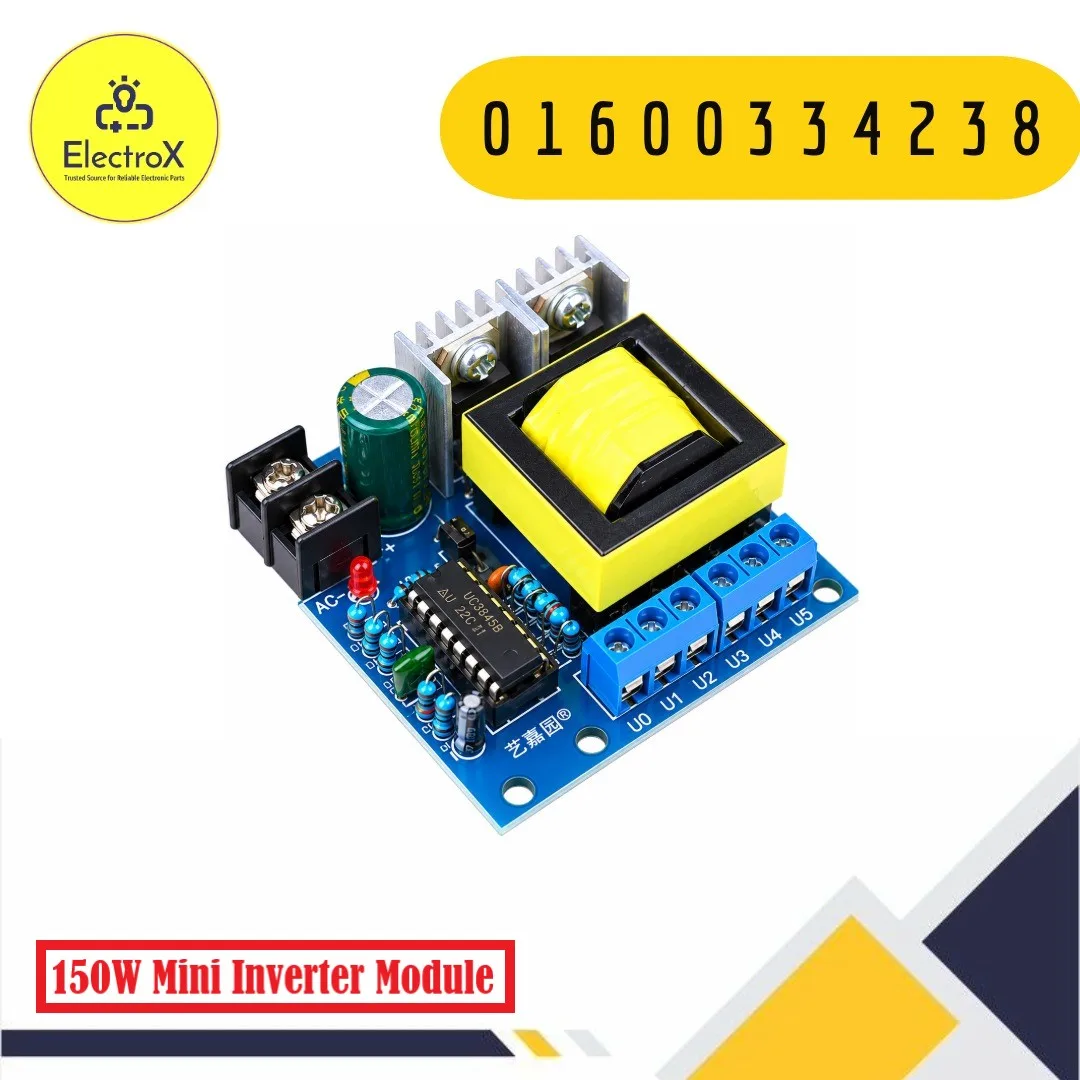
DC 12V to AC 220V 150W Mini Inverter Module
৳ 550
- 12V DC (typical module version)
- Rated Output Power: 150W
- Output Voltage: Selectable options may include 110V, 200V, 220V, and 280V
- Output Waveform: High-frequency square wave on common versions
- Operating Frequency: Approximately 20–37kHz, depending on board version
2 in stock
DC 12V to AC 220V 150W Mini Inverter Module Price in Bangladesh
The DC 12V to AC 220V 150W Mini Inverter Module is a compact power conversion board designed to increase a low-voltage DC supply to a much higher-voltage output. It is commonly used in electronics experiments, DIY inverter projects, battery-powered prototypes, and applications that require a high-voltage output from a 12V DC source.
An inverter module is useful when a project needs to convert electrical energy from a battery or DC power supply into an alternative output form. This module uses a switching circuit and transformer-based voltage conversion to generate a high-voltage output from a 12V input.
Depending on the exact version, the board may provide selectable output voltage connections such as 110V, 200V, 220V, and 280V. Some versions also provide a separate high-voltage DC output after the conversion stage. The output selection and terminal arrangement must be checked against the markings on the actual PCB.
The module is generally advertised with a 150W output rating. However, its real usable output depends on the input power supply, cooling, wiring, load characteristics, and operating conditions. A 12V source supplying 150W of output power must provide considerably more than 12.5A once conversion losses are included.
An important distinction is that common versions of this compact board generate high-frequency square-wave output, often around 20–37kHz. This is not the same as standard 220V, 50Hz household AC. It is therefore not a universal replacement for a conventional mains inverter and is unsuitable for many household appliances.
For electronics enthusiasts, students, and engineers, this module provides a compact platform for studying DC-to-AC conversion, transformer operation, switching circuits, and high-voltage power electronics.
What Is a DC-to-AC Inverter?
A DC-to-AC inverter is an electronic circuit that converts direct current (DC) into an alternating or alternating-like electrical output.
Batteries and most DC power supplies provide direct current, where the current flows in one direction. Many traditional AC-powered devices are designed to operate using alternating current, where the voltage changes polarity periodically.
An inverter uses electronic switching components to control current flow and generate an output waveform. A transformer or other voltage-conversion stage can then increase the output voltage.
Different inverter designs produce different waveforms:
- Square-wave inverter: Produces a square-shaped output waveform.
- Modified sine-wave inverter: Produces a stepped approximation of a sine wave.
- Pure sine-wave inverter: Produces an output waveform close to conventional utility electricity.
The common 150W mini inverter board described here uses high-frequency square-wave conversion. Its output should not be confused with a conventional 220V, 50Hz household supply.
Key Features of the DC 12V to AC 220V 150W Mini Inverter Module
1. 12V DC Input
The module is designed for a nominal 12V DC input, making it suitable for compatible 12V battery systems and laboratory DC power supplies.
A stable input supply with sufficient current capacity is essential. At higher output loads, the module can draw substantial current from the 12V source. An undersized power supply or thin connecting wire may cause voltage drop, overheating, or circuit failure.
Always check the input voltage range specified for the exact board version before connecting it.
2. High-Voltage Output
The main purpose of the module is to step up a low-voltage DC input to a high-voltage output.
Common board versions provide selectable output connections marked for approximately 110V, 200V, 220V, and 280V. These options are generally selected through PCB terminals or jumper arrangements.
The available output voltage depends on the specific terminal combination and the module design. It may also change with input voltage and connected load because many versions do not provide regulated output.
3. 150W Rated Power
The module is advertised with a 150W output power rating, making it suitable for selected low-power applications and electronics experiments.
The 150W rating should not be interpreted as a guarantee of continuous operation at that power under every condition. Thermal performance, input supply capacity, load type, and ventilation all affect the achievable output.
For sustained operation near the rated power, adequate cooling is important. Some common versions recommend additional fan cooling when operating above approximately 100W.
4. Compact PCB Design
The compact circuit-board construction makes the module convenient for experimental electronics, custom power conversion projects, and embedded power systems.
Its small form factor can help reduce the space required for a prototype compared with a complete enclosed inverter. However, the exposed high-voltage terminals require a properly designed protective enclosure before the module is incorporated into a finished product.
5. Screw-Terminal Connections
Many versions use screw terminals for the DC input and output connections. This makes wiring and installation convenient without requiring every connection to be soldered directly to the board.
Terminal assignments and output markings can vary. Always follow the PCB labels and the documentation supplied with the exact version.
6. High-Frequency Switching Operation
Common versions use a switching controller and power MOSFETs to drive the transformer stage. Depending on the production batch, controller and MOSFET part numbers may differ.
The high-frequency switching design allows the board to provide a compact voltage-conversion solution. However, it also means the output is not equivalent to conventional 50Hz household electricity.
Technical Specifications
| Parameter | Specification |
|---|---|
| Product Type | DC-to-AC mini inverter module |
| Input Voltage | 12V DC nominal |
| Typical input operating range | Approximately 8V–14.8V on some versions |
| Rated Output Power | 150W |
| Output Voltage Options | Commonly 110V / 200V / 220V / 280V |
| Output Waveform | High-frequency square wave |
| Operating Frequency | Approximately 20–37kHz, version-dependent |
| Voltage Selection | PCB terminal or jumper configuration, depending on version |
| No-load Current | Approximately 50–250mA on reported versions |
| Cooling | Additional cooling may be required at higher loads |
| Main Application | DIY inverter and power electronics projects |
| Protection | Many common boards lack comprehensive built-in protection |
Specifications are representative of commonly sold 150W mini inverter boards, not a universal specification for every production version. Confirm the actual PCB markings and supplier documentation before connecting a load.
Working Principle
The module operates through a switching-based voltage conversion process.
First, a 12V DC supply is connected to the input terminals. The switching circuit controls the power MOSFETs, causing current to flow through the transformer primary winding in a controlled switching pattern.
The transformer increases the voltage to a much higher level. Depending on the design, the output is made available through different transformer winding connections or output terminals.
The general conversion process can be understood in four stages:
- DC input: The module receives electrical power from a 12V DC battery or suitable power supply.
- Electronic switching: The controller drives the switching MOSFETs to generate a high-frequency alternating signal.
- Voltage transformation: The transformer increases the voltage from the low-voltage input side to the high-voltage output side.
- Output delivery: The converted high-voltage output is made available at the designated terminals.
The output waveform and frequency depend on the circuit design. On common versions, the output is a high-frequency square wave rather than a standard 50Hz sine wave.
Applications of the 150W Mini Inverter Module
DIY inverter projects: Useful as a conversion stage for experimental DC-to-high-voltage power electronics projects.
Electronics laboratory experiments: Helps students understand switching circuits, MOSFET operation, transformer-based voltage conversion, and inverter principles.
Resistive-load experiments: Can be used with compatible resistive loads within the module’s actual electrical and thermal limits.
High-voltage circuit research: Suitable for supervised experiments involving high-voltage conversion and compatible rectifier or multiplier circuits.
Battery-powered prototypes: Can be integrated into a carefully designed system using a suitable 12V battery, input protection, and appropriate enclosure.
Educational projects: Useful for demonstrating voltage conversion and power electronics concepts in engineering and technical education.
Electronic circuit development: Can serve as a building block for testing compatible high-voltage electronic circuits.
Advantages
- Compact design: A small PCB makes integration into experimental projects convenient.
- 12V DC input: Can operate from a suitable 12V DC power source.
- High-voltage conversion: Steps up a low-voltage input to a much higher output.
- 150W power class: Provides a useful power level for selected low-power experiments.
- Selectable output options: Some versions offer multiple output voltage connections.
- Convenient wiring: Screw terminals on common versions simplify installation.
- Useful educational platform: Helps demonstrate switching power conversion and transformer operation.
Limitations and Important Safety Considerations
1. Not a Standard Household Inverter
Common versions produce high-frequency square-wave output, not standard 220V, 50Hz AC. Do not assume that an appliance labelled 220V AC will operate correctly with this module.
2. Not Suitable for Conventional Motors and Fans
Avoid connecting AC motors, fans, pumps, iron-core transformers, and other inductive loads to the high-frequency output unless the manufacturer explicitly confirms compatibility.
3. High-Voltage Electric Shock Risk
The output can cause serious injury or death. Never touch exposed output terminals or wiring while the module is powered. Use an appropriate insulated enclosure and professional high-voltage precautions.
4. High Input Current
At 150W output, the input current from a 12V source can exceed 12.5A because conversion is not 100% efficient. Use a suitably rated power supply, short and adequately sized wires, and appropriate input protection.
5. Cooling Requirements
The switching components can become hot during operation. Provide adequate ventilation and additional cooling where required by the specific board.
6. Limited Protection on Common Versions
Some commonly sold boards do not include comprehensive overload, short-circuit, reverse-polarity, or thermal protection. Do not assume these protections are present. External protection and careful system design are essential.
7. Measurement Difficulties
A standard multimeter may provide misleading voltage readings when measuring high-frequency square-wave output. Use suitable measurement equipment rated for the voltage and frequency involved.
Installation and Usage Tips
- Check the input voltage requirements and terminal markings of the exact module version.
- Use a regulated or otherwise suitable 12V DC supply capable of delivering the required current.
- Install an appropriately rated external fuse close to the positive input source.
- Confirm input polarity before applying power.
- Select the correct output terminal configuration according to the PCB markings and documentation.
- Keep the high-voltage output terminals insulated and inaccessible during operation.
- Provide adequate ventilation and cooling, especially at higher output loads.
- Begin testing with a suitable low-power compatible load.
- Never overload or short-circuit the output.
- Disconnect the DC supply before changing wiring or output connections, and verify that stored energy has been safely discharged.
Why Choose the DC 12V to AC 220V 150W Mini Inverter Module?
The DC 12V to AC 220V 150W Mini Inverter Module is a compact option for electronics enthusiasts, engineering students, and developers exploring DC-to-high-voltage conversion.
Its small PCB format, 12V input, and high-voltage output make it useful for selected power electronics experiments and DIY inverter development. It can also help learners understand switching circuits, MOSFET-based conversion, and transformer operation.
However, selecting the correct load is essential. This module should be treated as a high-frequency inverter development board, not as a general-purpose household power inverter.
Why Buy from ElectroXBD?
ElectroXBD supplies electronic components, power modules, sensors, development boards, and robotics parts for students, hobbyists, engineers, educational institutions, and project developers in Bangladesh.
Whether you are building an electronics prototype, developing a university project, or experimenting with power conversion circuits, ElectroXBD provides an electronics-focused destination for sourcing components.
Business: ElectroXBD
Website: https://electroxbd.com
Contact / WhatsApp: 01600334238
Email: electroxbd@gmail.com
Address: H#1/1, Opposite of RH Chhatrabash, Vodra-Talaimari Road, Rajshahi, Bangladesh.
Frequently Asked Questions (FAQ)
1. What is the DC 12V to AC 220V 150W mini inverter module used for?
It is used to convert a 12V DC input into a high-voltage output for compatible electronics experiments, DIY inverter projects, and selected resistive-load applications.
2. Can this module convert 12V DC into 220V AC?
Yes. Common versions provide a selectable output connection for approximately 220V. The actual voltage depends on the board version, input supply, output terminals, and connected load.
3. Does this inverter module produce pure sine-wave output?
No. Common versions produce high-frequency square-wave output. This is different from pure sine-wave electricity and standard 220V, 50Hz household AC.
4. Can I use this module to operate a household fan?
No. Conventional AC fans are inductive loads and are not suitable for the high-frequency square-wave output of common versions.
5. What is the maximum output power?
The advertised rated output power is 150W. Actual usable power depends on cooling, input supply capacity, wiring, load type, and the specific board version.
6. Can I power the module using a 12V battery?
Yes. A suitable 12V battery can be used if it can safely provide the required input current. Proper fusing and wiring are essential.
7. Does the module support different output voltages?
Some versions provide selectable output connections such as 110V, 200V, 220V, and 280V. Check the PCB markings and documentation before making connections.
8. Does the inverter module require a cooling fan?
Additional cooling may be necessary during sustained operation at higher loads. Some common versions recommend a fan when operating above approximately 100W.
9. Can I connect a mobile charger or LED light?
Compatibility cannot be guaranteed simply from the device’s wattage. The high-frequency square-wave output may not work correctly with electronic power supplies or LED drivers. Confirm compatibility with the module manufacturer and connected device specifications.
10. Where can I buy a DC 12V to AC 220V 150W Mini Inverter Module in Bangladesh?
You can buy the DC 12V to AC 220V 150W Mini Inverter Module from ElectroXBD, a trusted electronics components supplier in Bangladesh. Visit https://electroxbd.com or contact 01600334238 for assistance.
Common Questions:
Q: What is the price of DC 12V to AC 220V 150W Mini Inverter Module in Bangladesh?
A: The latest price of DC 12V to AC 220V 150W Mini Inverter Module in Bangladesh is 550 BDT.
Q: Where to buy DC 12V to AC 220V 150W Mini Inverter Module in Bangladesh?
A: You can buy the DC 12V to AC 220V 150W Mini Inverter Module at the best price from ElectroXBD in Bangladesh.
Only logged in customers who have purchased this product may leave a review.
FAQs
Related products
-
XH-M203 Automatic Water Level Controller Module
Original price was: ৳ 450.৳ 350Current price is: ৳ 350.Add to cart- Input Voltage: 12V DC, suitable for standard low-voltage power supplies.
- Control Range: Automatically controls water levels between two pre-set sensor points.
- Maximum Load Current: 10A, capable of handling pumps or valves with significant power requirements.
- Relay Output: Supports high-power devices with its relay output, ensuring reliable operation.
- LED Indicators: Equipped with LED indicators for easy monitoring of power status and water level detection.
-
ZB2L3 HW586 Battery Capacity Tester Module
Original price was: ৳ 300.৳ 250Current price is: ৳ 250.Add to cart- Measures Battery Capacity: The ZB2L3 HW586 tests battery capacity through constant current discharge.
- Supports Various Batteries: Compatible with 18650, Li-ion, NiMH, and lead-acid batteries.
- Clear LCD Display: Provides real-time voltage, current, and capacity readings.
- Adjustable Discharge Current: Allows customization of discharge current up to 3A.
- Over-discharge Protection: Automatically stops when battery voltage drops too low.




Reviews
There are no reviews yet.