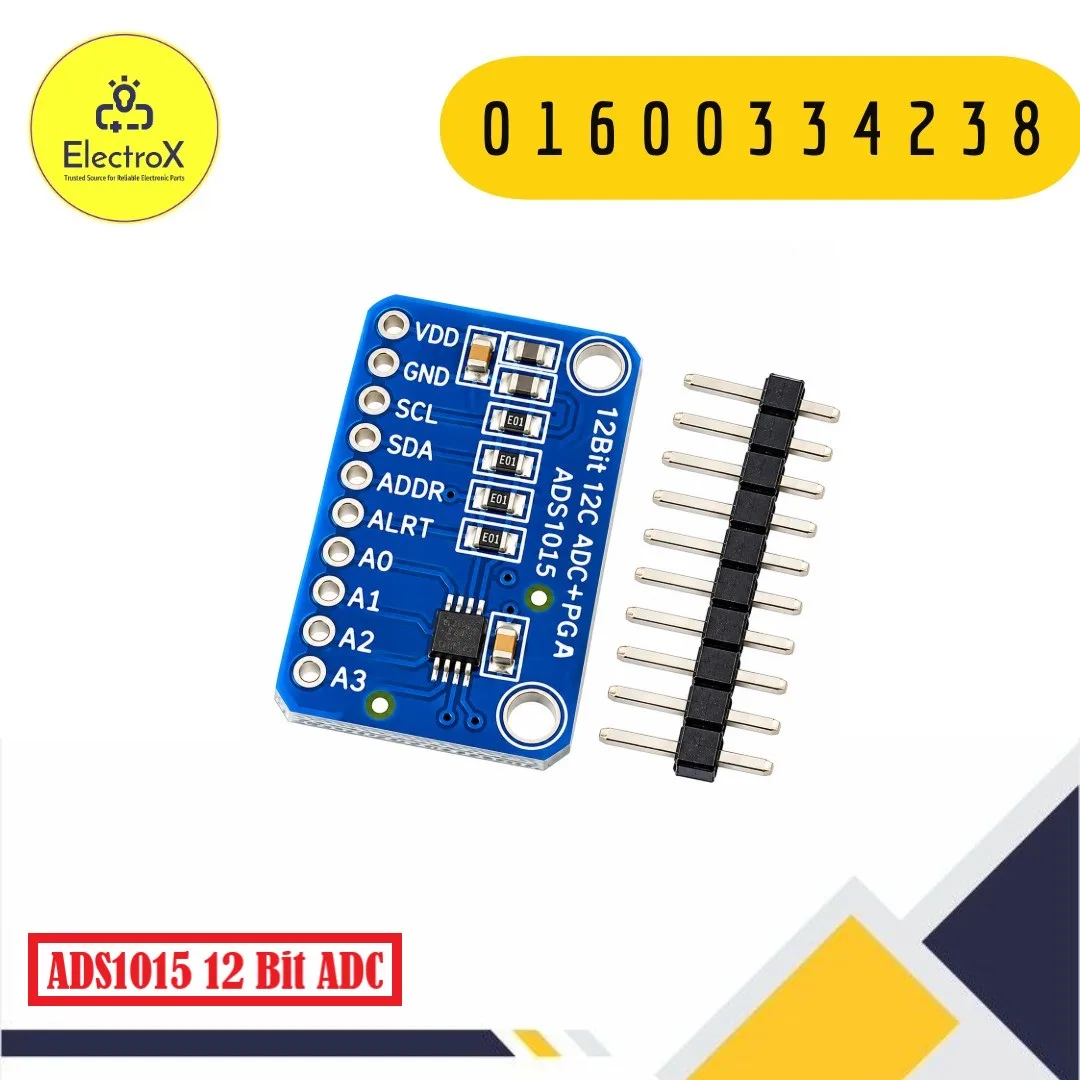
ADS1015 12 Bit Analog to Digital Converter
৳ 420
- ADC Resolution: 12-bit
- Analog Input Channels: 4 single-ended or 2 differential inputs
- Communication Interface: I2C
- Maximum Data Rate: 3300 samples per second (SPS)
- Operating Supply Voltage: 2.0V–5.5V for the ADS1015 IC
2 in stock
ADS1015 12-Bit Analog to Digital Converter Price in Bangladesh
The ADS1015 12-Bit Analog to Digital Converter Module is a useful electronics component for projects that require accurate analog signal measurement through a digital communication interface. It allows compatible microcontrollers to read analog voltages from sensors, signal-conditioning circuits, and other electronic devices without relying entirely on their built-in analog-to-digital conversion hardware.
Developed around the ADS1015 integrated circuit from Texas Instruments, this converter combines a 12-bit analog-to-digital converter, an input multiplexer, a programmable gain amplifier (PGA), an internal reference, and an I2C communication interface. The chip supports four single-ended analog input channels or two differential input channels, making it suitable for measuring multiple signals in a compact embedded system.
The module is particularly useful with Arduino boards, ESP32 development boards, Raspberry Pi systems, and other controllers that support I2C communication. It can simplify the process of collecting analog measurements from external sensors while reducing the number of microcontroller pins needed for communication.
Whether you are developing a sensor monitoring system, a science-fair prototype, an automated measurement instrument, or a data acquisition project, the ADS1015 provides a practical way to expand analog measurement capabilities.
What Is an Analog-to-Digital Converter?
An analog-to-digital converter, commonly known as an ADC, transforms a continuously varying analog voltage into a digital value that a microcontroller or computer can process.
Many electronic sensors generate analog output signals. Examples include certain temperature sensors, light sensors, pressure sensors, potentiometers, and voltage measurement circuits. A microcontroller cannot directly process an analog voltage as a digital number; an ADC measures the voltage and converts it into a numerical representation.
The ADS1015 performs this conversion with 12-bit resolution. A 12-bit result represents 4096 possible digital levels, from 0 to 4095 for a conventional unsigned representation. Differential measurements can also produce signed results. The exact voltage represented by each digital step depends on the selected programmable gain setting and the measurement configuration.
Compared with a basic 10-bit ADC, a 12-bit converter offers four times as many nominal digital levels across the same measurement range. This can help distinguish smaller voltage changes when the signal quality and measurement configuration support it.
Key Features of the ADS1015 ADC Module
1. 12-Bit Analog-to-Digital Conversion
The ADS1015 provides 12-bit conversion resolution for measuring analog signals. Its 4096 nominal output levels allow more detailed voltage measurements than a 10-bit ADC across an equivalent input range.
This feature is useful for sensor projects that need to detect relatively small changes in an analog signal. Actual measurement accuracy also depends on noise, sensor quality, circuit design, calibration, and other electrical conditions.
2. Four Single-Ended Analog Input Channels
The ADS1015 supports four single-ended analog inputs, commonly labelled A0, A1, A2, and A3 on breakout boards.
These channels let you connect several analog signal sources to one ADC module. For example, a project could monitor multiple voltage outputs or read several analog sensors using a single I2C connection to the microcontroller.
The chip also supports two differential input configurations, allowing it to measure the voltage difference between selected pairs of inputs.
3. I2C Communication Interface
The I2C interface allows the ADS1015 to communicate using two signal lines: SDA for data and SCL for the clock. Power and ground connections are also required.
Because I2C uses only two communication lines, the module is convenient for compact circuits and systems that already have other I2C-compatible components, such as displays, real-time clocks, and sensor modules.
4. Programmable Gain Amplifier
The integrated programmable gain amplifier allows users to select from several input measurement ranges. The ADS1015 supports nominal full-scale ranges of ±6.144V, ±4.096V, ±2.048V, ±1.024V, ±0.512V, and ±0.256V.
Selecting a smaller suitable range can improve the resolution available for measuring low-level signals. However, these are ADC measurement ranges, not permission to apply voltages above the chip’s supply rails. The analog inputs must remain within their permitted electrical limits.
5. High-Speed Conversion Options
The ADS1015 supports selectable data rates from 128 SPS up to 3300 SPS. Lower rates can be useful when slower measurements are sufficient, while higher rates can support faster signal sampling.
The maximum rate applies to conversions, not necessarily to a complete four-channel measurement cycle. When multiple channels are read in sequence, the total time required depends on the selected data rate, conversion configuration, and software overhead.
6. Compact and Low-Power Design
The ADS1015 integrated circuit is designed for low-power operation and compact electronic systems. Breakout boards make it easier to integrate the chip into prototypes without designing a custom circuit board around the small IC package.
This makes the module practical for educational electronics, portable instruments, embedded monitoring, and research prototypes.
Technical Specifications
| Parameter | Specification |
|---|---|
| Main IC | Texas Instruments ADS1015 |
| ADC resolution | 12-bit |
| Conversion architecture | Delta-sigma |
| Single-ended inputs | 4 |
| Differential inputs | 2 |
| Communication | I2C |
| Maximum data rate | 3300 SPS |
| Programmable gain | Yes |
| Full-scale measurement settings | ±0.256V to ±6.144V |
| IC supply voltage | 2.0V–5.5V |
| I2C address options | Four selectable addresses |
| Common default I2C address | 0x48 |
| Typical breakout-board connections | VDD, GND, SDA, SCL, A0–A3; other pins may be available |
| Operating temperature | -40°C to +125°C for the IC |
| Typical applications | Sensor measurement, voltage monitoring, data acquisition |
Specifications are based on the ADS1015 IC documentation. The pin arrangement, onboard components, and supported supply voltage of the finished breakout board can vary by manufacturer.
Working Principle of the ADS1015
The ADS1015 receives an analog voltage through one of its input channels. Its internal circuitry samples and converts the signal into a digital representation using a delta-sigma conversion architecture.
The input multiplexer selects the channel to be measured. The programmable gain amplifier applies the selected measurement range, and the ADC converts the signal. The resulting digital data can then be read by a microcontroller through I2C.
A typical measurement sequence works as follows:
- Connect the module’s power, ground, SDA, and SCL pins to a compatible controller.
- Connect the analog signal to one of the available input channels.
- Configure the ADC’s input channel, gain setting, and conversion data rate in software.
- Start or request a conversion using a compatible library or register-level code.
- Read the conversion result over I2C and convert it into a voltage using the selected configuration.
The ADS1015 is commonly used with Arduino libraries that handle register configuration and conversion scaling, making it easier to integrate into a project.
Applications of the ADS1015 ADC Module
Arduino and ESP32 projects: Expand analog measurement options when a project needs additional input channels or different measurement settings.
Sensor data acquisition: Read analog outputs from compatible temperature, light, pressure, and other sensor circuits.
Battery voltage monitoring: Measure a suitably scaled battery voltage for monitoring and logging. Use an appropriate voltage divider and ensure the ADC input stays within its permitted range.
Laboratory instruments: Add analog measurement functionality to educational instruments, test fixtures, and research prototypes.
Industrial monitoring prototypes: Read conditioned analog signals in low-voltage monitoring systems. Industrial signals may require suitable isolation, protection, and signal conditioning.
Environmental monitoring: Collect analog sensor readings for data logging, microcontroller-based monitoring, and automated experiments.
Robotics and automation: Measure analog feedback signals from potentiometers and other compatible sensing circuits.
Science-fair and academic projects: Build measurement systems that combine analog sensors, digital processing, displays, and data logging.
Advantages of the ADS1015
- Multiple input channels: Four single-ended inputs help reduce the need for separate ADC modules.
- Simple digital communication: I2C uses only two signal lines for communication.
- Flexible measurement range: Programmable gain supports different signal amplitudes.
- Selectable conversion rates: Users can balance sampling speed and measurement requirements.
- Broad controller compatibility: Suitable for many microcontrollers and embedded platforms with compatible I2C interfaces.
- Useful for prototyping: Breakout boards make it easier to test circuits before designing a custom PCB.
- Compact integration: Combines conversion and supporting functions in one IC.
Limitations and Important Considerations
The ADS1015 is a 12-bit converter, not a 16-bit ADC. If a project prioritizes higher nominal resolution over conversion speed, the ADS1115 may be worth considering; it offers 16-bit resolution with a maximum data rate of 860 SPS.
The ADS1015’s input voltage must remain within its specified electrical limits. A programmable gain setting does not make the input pins safe for arbitrary voltages. Use voltage dividers, buffers, or suitable signal-conditioning circuits where necessary.
Also remember that the four channels are multiplexed rather than sampled simultaneously. Projects requiring simultaneous sampling across multiple channels may need a different ADC architecture.
Finally, the actual performance of a measurement system depends on the complete circuit, including the sensor, grounding, wiring, power supply, and software configuration.
Installation and Usage Tips
- Check the module pin labels: Identify VDD, GND, SDA, and SCL before connecting power.
- Use a compatible supply: Follow the breakout board’s specifications rather than assuming every board supports the same voltage.
- Confirm I2C addressing: The common default address is 0x48, but the address can change with the ADDR connection.
- Select the correct gain: Choose a measurement range suitable for the expected input signal.
- Protect the analog inputs: Never apply a voltage that exceeds the chip’s permitted input limits.
- Use a suitable library: Configure the channel and gain correctly, and use the library’s documented method for converting raw readings into voltage.
- Test with a known voltage: Verify readings using a safe, known reference before connecting sensitive sensors or a larger circuit.
Why Choose the ADS1015 12-Bit ADC?
The ADS1015 is a practical option for electronics enthusiasts, students, engineers, and researchers who need additional analog input capability and flexible voltage measurement. Its combination of four input channels, programmable gain, and I2C communication makes it useful for a wide range of measurement and automation projects.
For users working with Arduino, ESP32, Raspberry Pi, or other embedded platforms, this module can simplify the integration of analog signals into a digital system. It is particularly useful when a project requires multiple sensor readings and configurable measurement ranges without a complicated interface.
Why Buy from ElectroXBD?
ElectroXBD supplies electronic components, development modules, sensors, and robotics parts for students, hobbyists, engineers, educational institutions, and project developers in Bangladesh.
You can explore the ADS1015 ADC module and other electronics components through our website. Whether you are developing a university project, a science-fair prototype, a sensor monitoring system, or an embedded electronics product, ElectroXBD can help you source components for your work.
Business: ElectroXBD
Website: https://electroxbd.com
Contact / WhatsApp: 01600334238
Email: electroxbd@gmail.com
Address: H#1/1, Opposite of RH Chhatrabash, Vodra-Talaimari Road, Rajshahi, Bangladesh.
Frequently Asked Questions (FAQ)
1. What is the ADS1015 12-bit ADC module used for?
The ADS1015 converts analog voltage signals into digital data. It is commonly used for sensor measurement, voltage monitoring, data acquisition, and microcontroller projects.
2. How many analog inputs does the ADS1015 have?
It supports four single-ended analog input channels or two differential input channels.
3. Is the ADS1015 compatible with Arduino?
Yes. It can be used with compatible Arduino boards through I2C and a suitable ADS1015 library.
4. Can I use the ADS1015 with ESP32?
Yes. The ADS1015 can communicate with an ESP32 over I2C. Check the module’s voltage requirements and ensure the signal levels are compatible with the ESP32.
5. What is the maximum sampling rate of the ADS1015?
The maximum conversion data rate is 3300 samples per second. The effective rate for a complete measurement cycle can be lower when reading multiple channels.
6. What is the default I2C address of the ADS1015?
The common default address is 0x48. The available address depends on the configuration of the ADDR pin.
7. What is the difference between ADS1015 and ADS1115?
The ADS1015 provides 12-bit resolution and supports up to 3300 SPS. The ADS1115 provides 16-bit resolution and supports up to 860 SPS. The appropriate choice depends on the project’s resolution and speed requirements.
8. Can the ADS1015 measure battery voltage?
Yes, if the voltage is within the permitted input range. For a battery voltage higher than the ADC’s allowed input voltage, use a properly designed voltage divider or signal-conditioning circuit.
9. Does the ADS1015 support differential measurements?
Yes. It supports two differential input configurations as well as four single-ended input channels.
10. Where can I buy the ADS1015 ADC module in Bangladesh?
You can buy the ADS1015 12-Bit Analog to Digital Converter Module from ElectroXBD, a trusted electronics components supplier in Bangladesh. Visit https://electroxbd.com or contact 01600334238 for assistance.
Common Questions:
Q: What is the price of ADS1015 12 Bit Analog to Digital Converter in Bangladesh?
A: The latest price of ADS1015 12 Bit Analog to Digital Converter in Bangladesh is 420 BDT.
Q: Where to buy ADS1015 12 Bit Analog to Digital Converter in Bangladesh?
A: You can buy the ADS1015 12 Bit Analog to Digital Converter at the best price from ElectroXBD in Bangladesh.
Only logged in customers who have purchased this product may leave a review.
FAQs
Related products
-
M28 Bluetooth Audio Receiver Module
Original price was: ৳ 250.৳ 200Current price is: ৳ 200.Add to cart- M28 Bluetooth Audio Receiver Module enables wireless audio streaming.
- Compact design, ideal for DIY audio projects.
- Supports Bluetooth 4.2 for stable, high-quality connections.
- Easily integrates with amplifiers and speakers.
- Perfect for upgrading wired systems to Bluetooth.
-
XH-M203 Automatic Water Level Controller Module
Original price was: ৳ 450.৳ 350Current price is: ৳ 350.Add to cart- Input Voltage: 12V DC, suitable for standard low-voltage power supplies.
- Control Range: Automatically controls water levels between two pre-set sensor points.
- Maximum Load Current: 10A, capable of handling pumps or valves with significant power requirements.
- Relay Output: Supports high-power devices with its relay output, ensuring reliable operation.
- LED Indicators: Equipped with LED indicators for easy monitoring of power status and water level detection.





Reviews
There are no reviews yet.