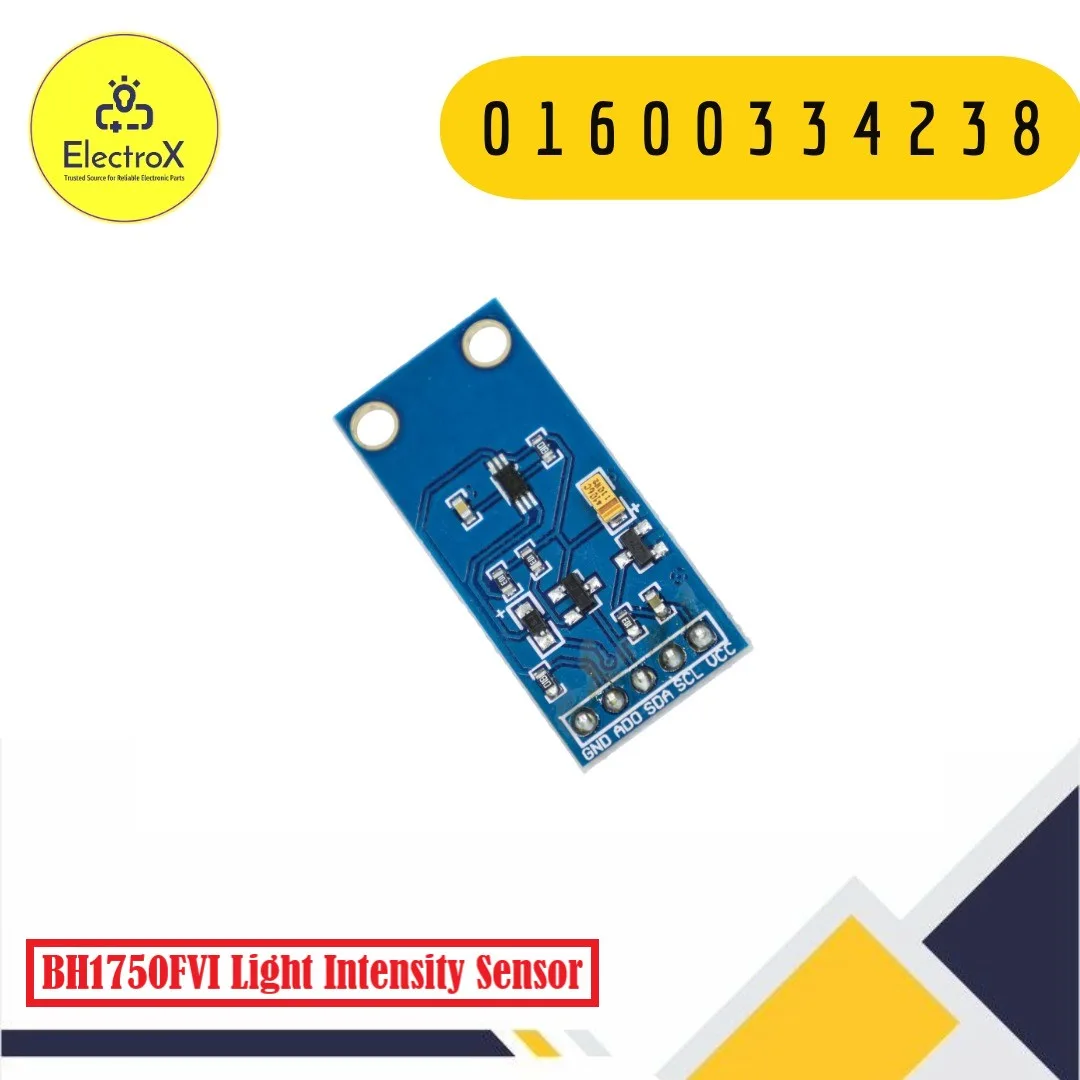
GY-30 BH1750FVI Digital Light Intensity Sensor
৳ 240
- Sensor IC: BH1750FVI
- Measurement: Ambient light intensity
- Unit: Lux (lx)
- Interface: I2C digital communication
- Typical Module: GY-30 breakout board
3 in stock
GY-30 BH1750FVI Digital Light Intensity Sensor Price in Bangladesh
The GY-30 BH1750FVI Digital Light Intensity Sensor is a compact ambient light sensing module designed to measure illumination and provide digital light-intensity data. Unlike a conventional LDR-based circuit that produces an analog voltage requiring additional calibration and ADC processing, the BH1750FVI provides digital light measurements through an I2C interface.
This makes the GY-30 module a convenient solution for Arduino, ESP32, Raspberry Pi, and other microcontroller-based projects where measuring environmental brightness is required. The sensor is particularly useful for automatic lighting systems, display brightness control, smart-home projects, environmental monitoring, robotics, and electronics experiments.
The module is commonly supplied as a small breakout board, making it easy to integrate into prototype circuits and development projects.
Overview of GY-30 BH1750FVI
The GY-30 is a popular breakout module based on the BH1750FVI digital ambient light sensor. It converts the intensity of visible light into a digital value that can be read directly by a compatible microcontroller.
The sensor communicates through the I2C bus, reducing the number of connections required and allowing it to share the communication bus with other compatible I2C devices.
One of the main benefits of the BH1750 approach is that the measured illumination is provided in lux, a commonly used unit for describing illuminance. This makes the sensor convenient for applications where the software needs to respond to actual changes in environmental brightness.
What Is a Digital Light Intensity Sensor?
A digital light intensity sensor detects the amount of light reaching its sensing element and converts the measurement into digital data.
The BH1750FVI is designed specifically for ambient-light measurement. Instead of requiring an external ADC to interpret an analog sensor voltage, the digital sensor processes the light measurement internally and communicates the result through I2C.
This makes it useful for systems that need software-controlled brightness detection and monitoring.
Key Features
- Based on BH1750FVI digital light sensor technology
- Measures ambient light intensity
- Provides readings in lux
- Digital I2C communication
- Compact GY-30 breakout-board design
- Easy integration with microcontroller projects
- Suitable for Arduino and ESP32
- Useful for Raspberry Pi projects
- Suitable for automatic lighting systems
- Useful for display brightness control
- No external analog ADC required for the digital sensor output
- Suitable for smart-home and IoT projects
- Useful for environmental light monitoring
- Simple wiring for prototyping
Technical Specifications
| Parameter | Specification |
|---|---|
| Module | GY-30 |
| Sensor IC | BH1750FVI |
| Sensor Type | Digital ambient light sensor |
| Measurement | Light intensity / illuminance |
| Measurement Unit | Lux (lx) |
| Communication | I2C |
| Output | Digital |
| Typical Address | 0x23; alternate address may be available depending on module configuration |
| Application | Ambient-light measurement |
| Compatible Platforms | Arduino, ESP32, Raspberry Pi and other I2C systems |
| Board Type | Breakout module |
| Operating Voltage | Depends on the specific GY-30 module version |
Note: GY-30 breakout boards from different manufacturers can have different onboard components and electrical specifications. Check the particular module version before connecting it to a 3.3V or 5V system.
Working Principle
The BH1750FVI detects ambient light using its integrated optical sensing circuitry. When light reaches the sensor, the device converts the detected optical information into a digital measurement.
The resulting data can be read by a microcontroller over the I2C communication interface. The controller sends the appropriate commands to the sensor and then reads the digital light-intensity result.
Because the output is digital, the microcontroller does not need to measure an analog voltage from the sensor. Software can then use the lux reading to make decisions, display the current illumination level, record environmental data, or automatically control another device.
For example, an automatic lighting project can monitor ambient illumination and use the sensor reading as an input for controlling LEDs or other lighting equipment.
Applications
The GY-30 BH1750FVI is suitable for a wide range of electronics and embedded-system applications, including:
- Arduino light measurement projects
- ESP32 ambient-light monitoring
- Raspberry Pi light sensing
- Automatic street-light projects
- Smart-home lighting systems
- Automatic LED brightness control
- LCD and display brightness adjustment
- IoT environmental monitoring
- Indoor illumination monitoring
- Light-level data logging
- Robotics projects
- Educational electronics experiments
- Solar and environmental monitoring prototypes
- Smart agriculture projects
- Portable lux-meter projects
- Day/night detection systems
Advantages
One of the main advantages of the GY-30 is its digital output. Compared with a basic LDR circuit, the module can provide a more convenient software interface for measuring ambient light because the sensor communicates directly through I2C.
The lux-based output also makes the sensor convenient for applications where the software needs to compare illumination levels. Its compact breakout-board format further simplifies prototyping with common development boards.
The I2C interface also allows multiple compatible devices to share the same communication bus, subject to address and hardware limitations.
Limitations
The GY-30 is intended primarily for ambient-light measurement and should not automatically be treated as a laboratory-grade optical measurement instrument.
The actual performance can depend on the sensor, module design, light source, installation environment, and surrounding optical conditions. Different breakout boards may also have different voltage-regulation and logic-level arrangements.
For specialized lighting measurement or calibrated professional instrumentation, a dedicated calibrated light meter or specialized optical sensor may be more appropriate.
Installation and Usage Tips
Connect the GY-30 to a compatible microcontroller using its I2C interface. The SDA and SCL connections should be connected to the appropriate I2C pins of the selected development board.
Before connecting the module, verify its particular operating-voltage requirements and whether the breakout board includes any voltage regulation or level shifting.
Position the sensor where it can receive the ambient light you want to measure. Avoid placing it directly behind opaque components or near a light source that does not represent the environment being monitored.
For consistent measurements, keep the sensor position and surrounding conditions reasonably stable. Software can then read the digital lux data and use it according to the requirements of the project.
Why Choose GY-30 BH1750FVI?
The GY-30 BH1750FVI is a practical option for projects that need digital ambient-light measurement without building a separate analog light-sensing circuit. Its compact design, I2C communication, and lux-based output make it convenient for Arduino, ESP32, Raspberry Pi, robotics, IoT, and smart-lighting applications.
It is particularly useful for students and electronics developers who want to learn about digital sensors, I2C communication, environmental monitoring, and automatic lighting control.
Why Buy from ElectroXBD?
ElectroXBD is a trusted source for reliable electronic parts in Bangladesh, supplying components and modules for Arduino, ESP32, Raspberry Pi, robotics, embedded systems, and DIY electronics projects.
The GY-30 BH1750FVI Digital Light Intensity Sensor is suitable for educational projects, prototypes, IoT systems, and practical light-monitoring applications.
ElectroXBD
Trusted Source for Reliable Electronic Parts
Office: H#1/1, Opposite of RH Chhatrabash, Vodra-Talaimari Road, Rajshahi
Website: electroxbd.com
Contact: 01600334238
Frequently Asked Questions (FAQ)
1. What is the GY-30 BH1750 sensor used for?
The GY-30 is used to measure ambient light intensity and provide the measurement digitally, typically in lux. It is useful for automatic lighting, IoT, robotics, and environmental monitoring projects.
2. Is GY-30 compatible with Arduino?
Yes. The GY-30 can be connected to Arduino boards through the I2C interface and used to read ambient-light measurements.
3. Can the GY-30 work with ESP32?
Yes. The GY-30 is commonly used with ESP32 development boards through I2C. The appropriate I2C pins and voltage compatibility should be checked for the specific ESP32 and GY-30 modules.
4. What is the output unit of the BH1750 sensor?
The BH1750 provides digital light-intensity measurements commonly represented in lux (lx), which is a standard unit of illuminance.
5. Does GY-30 use I2C communication?
Yes. The BH1750FVI communicates digitally through the I2C interface, requiring SDA and SCL connections along with the appropriate power connections.
6. What is the difference between GY-30 and an LDR?
An LDR typically provides an analog resistance or voltage change that must be interpreted by a circuit or ADC. The GY-30 uses the BH1750FVI to provide digital light-intensity data through I2C.
7. Can GY-30 be used for automatic lights?
Yes. A microcontroller can read the ambient-light level from the GY-30 and use that information as an input for an automatic lighting-control system.
8. Where can I buy GY-30 BH1750FVI in Bangladesh?
You can buy the GY-30 BH1750FVI Digital Light Intensity Sensor from ElectroXBD, a trusted electronics components supplier in Bangladesh.
Common Questions:
Q: What is the price of GY-30 BH1750FVI Digital Light Intensity Sensor in Bangladesh?
A: The latest price of GY-30 BH1750FVI Digital Light Intensity Sensor in Bangladesh is 240 BDT.
Q: Where to buy GY-30 BH1750FVI Digital Light Intensity Sensor in Bangladesh?
A: You can buy the GY-30 BH1750FVI Digital Light Intensity Sensor at the best price from ElectroXBD in Bangladesh.
Only logged in customers who have purchased this product may leave a review.
FAQs
Related products
-
MQ2 Gas and Smoke Sensor Module
৳ 150Add to cart- Detection Range: 200 to 10000 ppm (Parts Per Million) for combustible gases and smoke.
- Operating Voltage: 5V DC.
- Preheat Time: 20 seconds for optimal performance.
- Sensitivity: Adjustable via onboard potentiometer for different gas concentrations.
- Output: Analog and digital signals for easy integration with microcontrollers like Arduino.
-
MQ135 Air Quality Detection Sensor
৳ 170Add to cart- Operating Voltage: 5V DC.
- Detection Range: 10 – 1000 ppm (Ammonia, Benzene, Alcohol, Smoke).
- Preheat Time: Over 24 hours for accurate readings.
- Output: Analog output voltage proportional to gas concentration.
- Sensitivity: Adjustable via onboard potentiometer.
-
DHT22 Temperature and Humidity Sensor
Original price was: ৳ 350.৳ 250Current price is: ৳ 250.Add to cart- Temperature Range: -40°C to 80°C with ±0.5°C accuracy.
- Humidity Range: 0% to 100% relative humidity with ±2% accuracy.
- Operating Voltage: 3.3V to 6V DC.
- Output Type: Digital signal via a single data wire.
- Sampling Rate: 0.5 Hz (1 reading every 2 seconds).
-
AHT10 Digital Temperature & Humidity Sensor
Original price was: ৳ 200.৳ 160Current price is: ৳ 160.Add to cart- High Accuracy: ±0.3°C temperature, ±2% RH humidity.
- Measurement Range: -40°C to 85°C, 0% to 100% RH.
- Compact Size: Ideal for space-constrained applications.
- I2C Interface: Ensures easy integration with microcontrollers.
- Low Power Consumption: Suitable for battery-powered devices.

Reviews
There are no reviews yet.