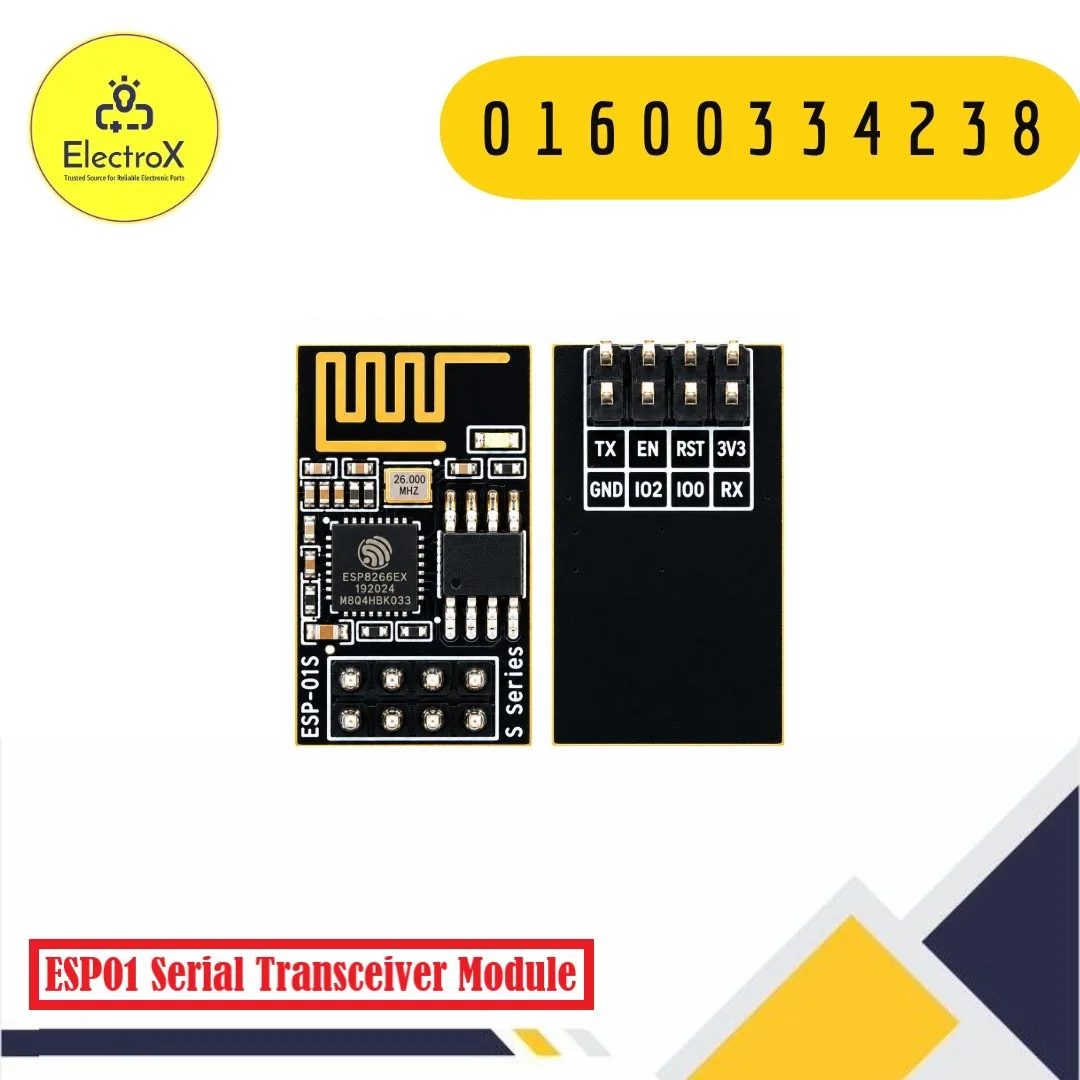
ESP01 ESP8266 Serial WiFi Transceiver Module
৳ 170
- Core Chip: ESP8266EX
- Wireless Standard: IEEE 802.11 b/g/n, 2.4GHz
- Operating Voltage: 3.0–3.6V DC; nominally 3.3V
- Communication Interface: UART serial
- Antenna: Integrated PCB antenna
4 in stock
ESP01 ESP8266 Serial WiFi Transceiver Module Price in Bangladesh
The ESP01 ESP8266 Serial WiFi Transceiver Module is a compact wireless communication solution that enables electronic devices and microcontrollers to connect to WiFi networks. Based on the ESP8266EX chip, it combines wireless networking capabilities with a serial interface, making it useful for embedded electronics and Internet of Things (IoT) applications.
Many traditional microcontrollers do not include built-in WiFi connectivity. The ESP01 can add wireless communication to compatible systems, allowing them to exchange data with computers, local servers, network applications and other devices over a supported WiFi connection.
The module operates on the 2.4GHz WiFi band and supports IEEE 802.11 b/g/n networking. Its UART interface allows a host controller, such as an Arduino, to communicate with the module using serial data. When compatible AT-command firmware is installed, the host can issue commands to configure WiFi, connect to a router and perform supported networking operations.
The ESP8266 can also run custom firmware, allowing the module to handle application logic and networking tasks itself. This means it can serve either as a WiFi communication interface for another microcontroller or as a small standalone embedded controller, subject to its limited GPIO availability and onboard memory.
The standard ESP01 form factor features an 8-pin header and an integrated PCB antenna. Its small footprint makes it suitable for compact electronics prototypes, wireless sensor systems, smart home projects and educational experiments.
One important consideration is its power supply. The ESP01 requires a regulated 3.3V supply and is not a 5V-powered module. WiFi transmission creates short current peaks, so a supply with adequate current capability is essential for stable operation.
What Is the ESP8266 WiFi Transceiver?
The ESP8266 is a WiFi-enabled system-on-chip developed by Espressif. It integrates a 32-bit processor and wireless networking functionality, allowing compatible hardware to communicate over WiFi.
The ESP01 is one of the compact module formats built around the ESP8266 family. It exposes selected power, control, serial and GPIO connections through an 8-pin header.
The term serial WiFi transceiver describes its ability to exchange data between a serial host interface and a wireless network. With suitable firmware, it can receive commands from a microcontroller, perform networking operations and return responses through UART.
For example, an Arduino can read a temperature sensor and send the measurement to the ESP01 over serial. The ESP8266 can then transmit that information to a compatible server or local network application. The exact networking functions depend on firmware and software configuration.
Key Features of the ESP01 ESP8266 Module
1. 2.4GHz WiFi Connectivity
The ESP01 supports IEEE 802.11 b/g/n WiFi on the 2.4GHz band. This allows compatible devices to communicate with supported wireless routers and network equipment.
WiFi connectivity makes the module useful for applications that need to transmit sensor readings, receive remote commands or exchange data with network services. It does not support 5GHz-only WiFi networks.
2. UART Serial Communication
The module uses a UART interface for communication with an external controller. Serial communication makes integration possible with Arduino boards and other microcontrollers that provide compatible UART signals.
When using AT firmware, the host controller sends commands and reads responses. With custom firmware, the UART can be used for application-specific communication or debugging.
3. AT Command Support
Compatible ESP8266 AT firmware allows the module to be controlled through text-based commands. Depending on firmware version, commands can configure WiFi mode, connect to an access point, manage network connections and transfer data.
The command set and available features depend on the installed firmware. A module flashed with custom firmware may not respond to the same AT commands until compatible AT firmware is installed.
4. Multiple WiFi Operating Modes
The ESP8266 platform supports several networking modes:
- Station mode: Connects to an existing WiFi router.
- Soft Access Point mode: Creates a WiFi network that compatible devices can join.
- Station + Access Point mode: Supports both roles simultaneously when enabled by the firmware.
These modes make the module useful for different types of wireless projects, from simple router-connected sensor systems to configuration interfaces for embedded devices.
5. Compact PCB Antenna
The standard ESP01 includes an integrated printed circuit board antenna. This avoids the need for a separate external antenna in many basic applications.
Wireless range depends on antenna placement, obstacles, interference, router performance and the surrounding environment. Keep the antenna area clear of metal and other objects that can interfere with radio performance.
6. Low-Power Operating Features
The ESP8266 supports different power-management modes, including modem sleep, light sleep and deep sleep. These features can help reduce energy consumption in applications that spend much of their time inactive.
Actual power consumption varies according to firmware, wireless activity, signal strength and hardware design. WiFi transmission requires significantly more current than deep-sleep operation.
7. Custom Firmware Development
The ESP8266 platform supports custom application development. Depending on the chosen toolchain and firmware, developers can implement wireless sensor reporting, web-server functionality, network communication and other embedded applications.
The standard ESP01 has limited exposed GPIO pins, so projects requiring many digital inputs or outputs may need additional hardware or a different development board.
Technical Specifications
| Parameter | Specification |
|---|---|
| Product name | ESP01 ESP8266 Serial WiFi Transceiver Module |
| Core chip | ESP8266EX |
| WiFi standard | IEEE 802.11 b/g/n |
| Operating frequency | 2.4GHz |
| Operating voltage | 3.0–3.6V DC |
| Recommended nominal supply | 3.3V DC |
| Power supply capability | Use a stable supply capable of at least 300mA; 500mA capacity provides additional margin |
| Communication interface | UART serial |
| Default baud rate | Commonly 115200 bps with standard AT firmware; firmware-dependent |
| GPIO | GPIO0 and GPIO2 exposed as general-purpose I/O, with TX/RX also available for serial functions |
| Antenna | Integrated PCB antenna |
| Flash memory | Common ESP01 versions often have 8Mbit (1MB); verify the specific variant |
| Network modes | Station, SoftAP and Station + SoftAP, depending on firmware |
| Logic level | 3.3V; not 5V tolerant |
| Header | 8-pin, 2-row interface |
| Typical module dimensions | Approximately 24.7 × 14.4mm, depending on revision |
| Typical applications | IoT, WiFi sensors, remote monitoring and embedded networking |
Specification note: ESP-01 and ESP-01S boards may differ in flash memory, component layout and firmware. Confirm the specific module revision before relying on memory capacity, pin details or default serial settings.
Working Principle
The ESP-01 operates as a wireless networking module controlled by serial commands or custom firmware.
When power is applied, the ESP8266 initializes its internal circuitry and starts the installed firmware. In AT-command mode, the host microcontroller communicates with the module through the UART TX and RX pins.
The host can instruct the module to scan for available networks, connect to a WiFi router or create an access point. Once connected, the firmware can manage supported TCP/IP operations and exchange data over the network.
For example, a microcontroller can send sensor data through the serial interface. The ESP01 receives the data, processes the applicable networking commands and transmits the information wirelessly. Responses from the network can be returned to the host through the serial interface.
When running custom firmware, the ESP8266 can perform these tasks independently without requiring another microcontroller for every application. The amount of processing, memory and GPIO functionality available depends on the module version and firmware design.
Applications of the ESP01 ESP8266 WiFi Module
1. Arduino WiFi Connectivity
Add WiFi communication to compatible Arduino projects using serial commands or a suitable communication library. The Arduino handles the application logic while the ESP-01 provides network access.
2. Wireless Sensor Monitoring
Transmit temperature, humidity, light or other sensor readings to a local server or network dashboard. The sensor and host controller must be selected according to the required measurement and processing functions.
3. Smart Home Automation
Use the module in compatible systems that monitor sensors or receive remote commands over WiFi. Additional switching circuitry and suitable electrical protection are required to control appliances safely.
4. IoT Data Transmission
Send measurements or status information to a compatible IoT platform through a WiFi network. The module can support low-cost connected-device prototypes when its firmware and network configuration meet the application’s needs.
5. Remote Control Projects
Develop a wireless control interface for compatible electronic devices. A network application or server can exchange commands with the module, while the host firmware determines how those commands are handled.
6. Local Web Server Projects
With suitable custom firmware, the ESP8266 can host a small web interface for configuration or device control. Memory and processing limitations should be considered when designing the web application.
7. Wireless Data Logging
Transmit data collected by a microcontroller to a computer or network service for storage and analysis. A suitable server or software platform is needed to receive and store the readings.
8. Educational Embedded Systems
Use the ESP01 to learn about UART communication, WiFi networking, TCP/IP, AT commands and embedded IoT design.
9. Network-Connected Prototypes
The module is suitable for testing wireless communication concepts before moving to a more capable ESP8266 or ESP32 development board for larger projects.
Advantages of the ESP01 Module
- Compact design: Fits into small electronic prototypes.
- WiFi connectivity: Adds 2.4GHz wireless networking to compatible systems.
- Serial interface: Makes communication with external microcontrollers straightforward.
- AT-command option: Allows network operations without writing a complete custom firmware application.
- Standalone capability: The ESP8266 can run custom firmware and perform application tasks itself.
- Multiple network modes: Supports station and access-point configurations with suitable firmware.
- Low-power modes: Offers options for reducing consumption during inactive periods.
- Affordable development platform: Useful for learning and prototyping wireless embedded systems.
Limitations and Important Considerations
- 3.3V only: Applying 5V directly to the module’s power or signal pins can damage it.
- Limited GPIO availability: The standard ESP-01 exposes only a small number of convenient general-purpose I/O pins.
- Current peaks during WiFi activity: An inadequate supply can cause unexpected resets or connection failures.
- 2.4GHz WiFi only: It cannot connect directly to a 5GHz-only network.
- Firmware dependence: AT commands, serial speed and supported functions depend on the installed firmware.
- Limited flash and RAM: The module is not intended for every application that requires extensive memory or complex processing.
- No onboard USB interface: Programming generally requires a suitable USB-to-UART adapter or programmer.
- Antenna placement matters: Nearby metal and poor placement can reduce wireless performance.
Installation and Usage Tips
- Use a regulated 3.3V supply: Never connect the module’s VCC pin directly to 5V.
- Provide sufficient current: Use a supply capable of handling WiFi transmission peaks. A 3.3V regulator rated for at least 300mA, preferably with 500mA capacity, is a practical starting point.
- Connect common ground: When communicating with an external controller, connect the module’s GND to the controller’s GND.
- Cross the UART lines: Connect ESP-01 TX to the host’s RX and ESP-01 RX to the host’s TX.
- Protect the signal pins: Use appropriate level shifting when connecting to a 5V UART. The ESP-01’s RX pin is not designed for direct 5V logic.
- Enable the module: The CH_PD/EN pin must be held high at the appropriate logic level for normal operation.
- Check boot pins: GPIO0 and GPIO2 have boot-configuration requirements. Incorrect external connections can prevent normal startup.
- Verify the baud rate: Start with the serial settings supported by the installed firmware, commonly 115200 bps for many AT firmware versions.
- Test using AT commands: If AT firmware is installed, begin with a basic
ATcommand and confirm that the module responds before configuring the network. - Place the antenna carefully: Avoid placing metal directly over the PCB antenna area.
Why Choose the ESP-01 ESP8266 Serial WiFi Transceiver Module?
The ESP-01 is a practical option for developers who need basic WiFi connectivity in a small embedded system. Its UART interface, AT-command support and custom firmware options make it flexible for both microcontroller-assisted and standalone wireless projects.
It is particularly useful for adding network communication to sensor systems, remote monitoring devices and small IoT prototypes. Correct power supply design and 3.3V logic compatibility are essential for stable operation.
Why Buy from ElectroXBD?
ElectroXBD supplies electronic components, development modules, sensors and robotics parts for students, educators, hobbyists and engineers in Bangladesh.
Whether you are developing an Arduino WiFi project, an IoT sensor system, a smart home prototype or a wireless monitoring device, ElectroXBD can help you source components for your electronics projects.
Contact and ordering information
- Website: https://electroxbd.com
- WhatsApp / Mobile: 01600334238
- Email: electroxbd@gmail.com
- Address: H#1/1, Opposite of RH Chhatrabash, Vodra-Talaimari Road, Rajshahi, Bangladesh.
Frequently Asked Questions (FAQ)
1. What is the ESP-01 ESP8266 WiFi Module used for?
It adds 2.4GHz WiFi connectivity to electronic devices and microcontrollers. It is commonly used for IoT projects, wireless sensor monitoring and remote communication.
2. Can I use the ESP-01 with Arduino?
Yes. The ESP-01 can communicate with an Arduino through UART using compatible AT firmware or custom communication software. You must provide a suitable 3.3V supply and protect the module from 5V signals.
3. What voltage does the ESP-01 require?
The module requires a regulated supply within approximately 3.0–3.6V, with 3.3V being the usual nominal supply voltage.
4. Can I power the ESP01 directly from an Arduino 5V pin?
No. Do not connect 5V directly to the ESP01’s VCC or 3.3V-only signal pins. Use a suitable 3.3V regulator and compatible UART logic levels.
5. Does the ESP01 support 5GHz WiFi?
No. It supports WiFi on the 2.4GHz band and cannot connect directly to a 5GHz-only wireless network.
6. How many GPIO pins are available on the ESP01?
GPIO0 and GPIO2 are the main general-purpose I/O pins exposed on the standard module. The UART TX and RX pins may also have alternate uses, but repurposing them affects serial communication.
7. What is the default baud rate of the ESP01?
Many AT-firmware versions use 115200 bps by default, but the actual setting depends on the installed firmware and configuration.
8. Can the ESP01 work without another microcontroller?
Yes. The ESP8266 can run custom firmware and perform networking and application tasks on its own. The standard ESP01 has limited exposed GPIO, so more complex hardware projects may benefit from a development board with additional pins.
9. Why does my ESP01 keep restarting or fail to connect to WiFi?
Common causes include an inadequate 3.3V power supply, incorrect UART wiring, incompatible logic levels, boot-pin configuration problems, incorrect credentials or weak WiFi signal. Check the supply during transmission and confirm the firmware’s serial settings.
10. Where can I buy the ESP01 ESP8266 WiFi Module in Bangladesh?
You can buy the ESP01 ESP8266 Serial WiFi Transceiver Module from ElectroXBD, a trusted electronics components supplier in Bangladesh. Visit https://electroxbd.com or contact WhatsApp/mobile 01600334238 for product availability and ordering information.
Common Questions:
Q: What is the price of ESP01 ESP8266 Serial WiFi Transceiver Module in Bangladesh?
A: The latest price of ESP01 ESP8266 Serial WiFi Transceiver Module in Bangladesh is 170 BDT.
Q: Where to buy ESP01 ESP8266 Serial WiFi Transceiver Module in Bangladesh?
A: You can buy the ESP01 ESP8266 Serial WiFi Transceiver Module at the best price from ElectroXBD in Bangladesh.
Only logged in customers who have purchased this product may leave a review.
FAQs
Related products
-
XH-M601 Battery Charging Control Module
Original price was: ৳ 250.৳ 200Current price is: ৳ 200.Add to cart- Input Voltage: 10V-30V DC.
- Output Voltage: Adjustable, typically 12V, 24V, etc.
- Charging Current: Up to 20A (adjustable based on battery requirements).
- Protection Features: Overcharge, over-discharge, and reverse polarity protection.
- Battery Types Supported: Lead-acid and lithium batteries.
-
4 Channel Relay Module
Original price was: ৳ 299.৳ 250Current price is: ৳ 250.Add to cart- Operating Voltage: 5V DC for reliable performance.
- Relay Capacity: Supports up to 250V AC/10A or 30V DC/10A.
- Trigger Type: Low-level trigger for easy microcontroller integration.
- Indicator LEDs: Built-in status LEDs for each relay channel.
- Compatibility: Works with Arduino, Raspberry Pi, and other microcontrollers.


Reviews
There are no reviews yet.