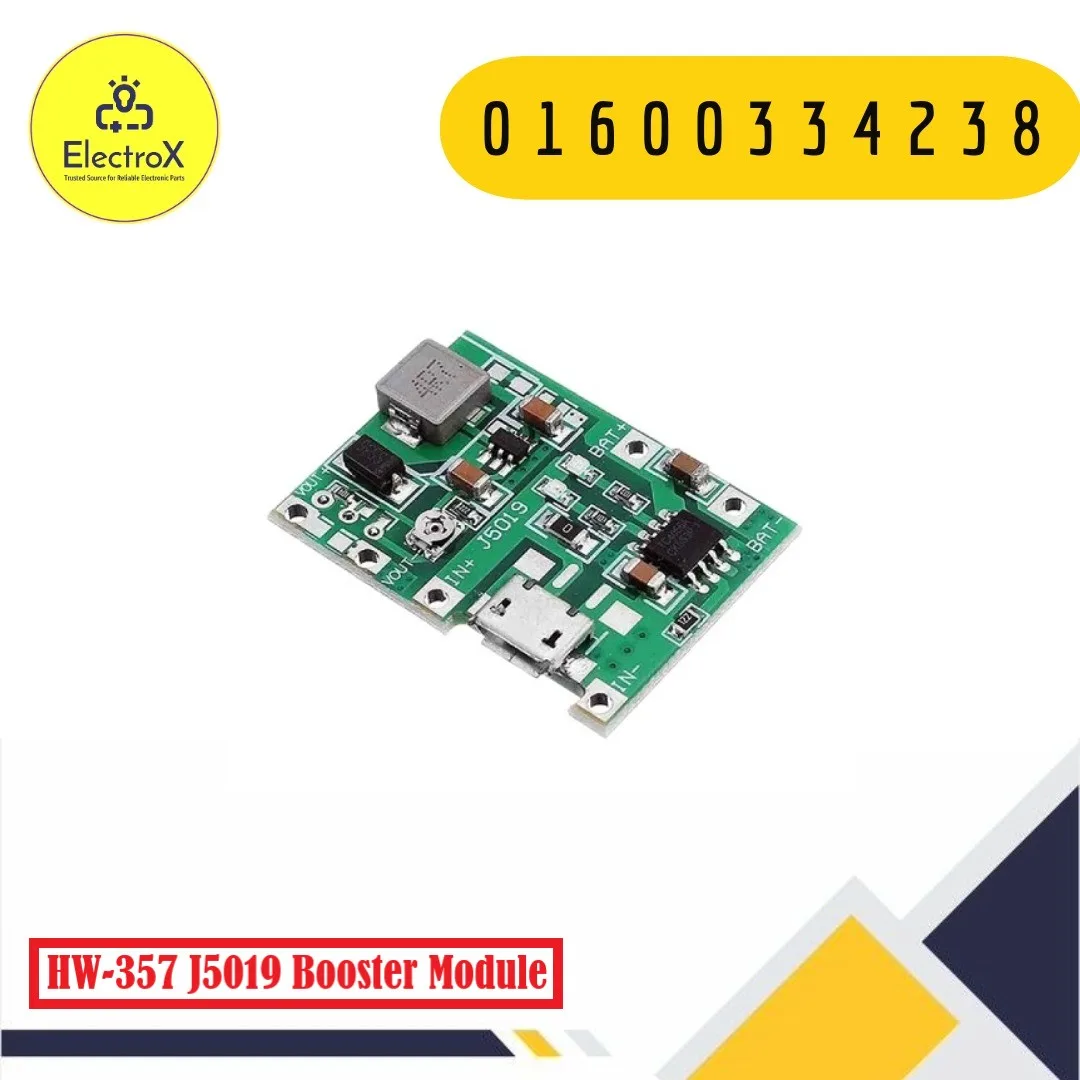
HW-357 J5019 3.7V to 5V 9V 12V Booster Module
৳ 70
- Model: HW-357 / J5019
- Compatible Battery: Single-cell 3.7V nominal Li-ion or LiPo
- Charging Input: Typically 4.5V–8V DC; 5V recommended
- Adjustable Boost Output: Approximately 4.3V–27V on common versions
- Charging Voltage and Current: 4.2V, up to approximately 1A
25 in stock
HW-357 J5019 Booster Module Price in Bangladesh
The HW-357 J5019 Booster Module is a compact power-management board designed to charge a single-cell lithium battery and increase its voltage to a higher DC output. It combines a lithium battery charging circuit with a boost converter, making it useful for portable electronics, battery-powered equipment and DIY power supply projects.
A standard single-cell lithium-ion battery has a nominal voltage of 3.7V and reaches approximately 4.2V when fully charged. However, many electronic devices require a higher supply voltage, such as 5V, 9V or 12V. The HW-357 module addresses this requirement by stepping up the battery voltage to an adjustable output level.
On commonly documented HW-357/J5019 versions, the output can be adjusted across approximately 4.3V–27V. This means that 5V, 9V and 12V are possible settings rather than three separate fixed outputs. The actual adjustment range and current capability should be verified against the supplied board.
The module also includes a charging circuit intended for a single-cell 3.7V nominal Li-ion or LiPo battery. It typically accepts a 5V USB supply or another suitable DC input within its specified input range and charges the battery to approximately 4.2V.
This combination is especially useful when a project needs both rechargeable battery support and a higher operating voltage without requiring separate charging and boost boards.
The HW-357 is suitable for hobby electronics, student projects, portable instruments, DIY power supplies and other low-power applications. However, it is important to understand its current limits and battery-protection limitations before using it in a permanent design.
What Is a DC-DC Boost Converter?
A DC-DC boost converter is an electronic circuit that increases a DC input voltage to a higher DC output voltage. It is also known as a step-up converter.
For example, a boost converter can take the voltage from a single-cell lithium battery and produce a higher voltage for a compatible electronic device. The converter uses switching electronics and an inductor to transfer energy from the input to the output.
The output voltage can often be adjusted with a small potentiometer on the board. On the HW-357, this adjustment allows the user to select a suitable voltage for a compatible load.
A boost converter does not create additional energy. When the output voltage increases, the available output current generally decreases because the input power is limited by the battery, converter efficiency and circuit design.
This is why the module may provide more current at 5V than at 9V or 12V.
Key Features of the HW-357 J5019 Booster Module
1. Adjustable DC Output Voltage
The module provides an adjustable boosted output. Commonly documented versions offer an approximate output range of 4.3V–27V, allowing users to select a suitable voltage for various low-power electronics applications.
The output can be adjusted for 5V devices, compatible 9V circuits and 12V electronics. Always measure the output with a multimeter before connecting a device, particularly when the load requires a precise supply voltage.
2. Integrated Lithium Battery Charging
The HW-357 combines a single-cell lithium battery charger with the boost converter. This allows a compatible 3.7V nominal Li-ion or LiPo battery to be charged from a suitable external DC supply.
The charging circuit typically terminates charging at approximately 4.2V and supports a charging current of up to around 1A on common versions. The actual current depends on the board design, input supply, thermal conditions and battery requirements.
3. Suitable for 18650 Battery Projects
The module is commonly used with one compatible 18650 lithium-ion cell. It can also be used with an appropriate single-cell LiPo battery.
A battery’s nominal voltage alone does not guarantee compatibility. Confirm its chemistry, maximum charging voltage, safe charging current and discharge limits before connecting it.
4. Multiple Output Voltage Options
The adjustable output allows the same board to serve different project requirements. Typical settings include:
- 5V: Suitable for compatible small electronics and low-power accessories.
- 9V: Useful for compatible 9V circuits and selected portable devices.
- 12V: Suitable for certain 12V electronic loads within the module’s current capability.
These are adjustable output settings, not independent fixed-output channels. The output must be measured and set before connecting the intended load.
5. Compact Circuit Board
The HW-357 is a small PCB that can fit into many portable electronic projects. Common versions measure approximately 33 × 23mm, although dimensions may vary with connector type and board revision.
Its compact design can help reduce the space required for a rechargeable power supply.
6. Charging Status Indicators
Many versions include onboard LEDs to indicate charging status. Their colour and behaviour can vary by board revision, so consult the markings or documentation for the specific module.
These indicators provide a convenient visual reference during charging, but they do not replace proper battery monitoring or protection.
7. USB and DC Input Options
Common boards provide a Micro USB input and separate solder pads for an external DC charging supply. Some newer or alternate versions use USB Type-C instead.
Check the physical connector on the supplied module. Do not assume every HW-357/J5019 board uses the same connector or pin layout.
Technical Specifications
| Parameter | Specification |
|---|---|
| Product name | HW-357 J5019 Booster Module |
| Main function | Lithium battery charger and adjustable DC-DC boost converter |
| Battery configuration | Single-cell, 1S |
| Compatible battery | 3.7V nominal Li-ion or LiPo |
| Typical charging input | 4.5V–8V DC |
| Recommended input | 5V DC |
| Charging voltage | Approximately 4.2V |
| Maximum charging current | Up to approximately 1A |
| Adjustable output range | Approximately 4.3V–27V on common versions |
| Typical output current at 5V | Up to approximately 1.4A |
| Typical output current at 9V | Up to approximately 0.8A |
| Typical output current at 12V | Up to approximately 0.6A |
| Battery-side discharge current | Approximately 2A maximum on commonly documented versions |
| Quiescent current | Approximately 0.5mA on common versions |
| Input connector | Micro USB or other connector, depending on version |
| Output adjustment | Onboard potentiometer |
| Typical board dimensions | Approximately 33 × 23mm |
| Common applications | Portable power supplies, DIY power banks and battery-powered electronics |
Specification note: Current figures are approximate reference values from commonly sold HW-357/J5019 versions, not guaranteed continuous output ratings for every board. Actual performance depends on battery voltage, battery discharge capability, load, wiring, cooling and converter efficiency.
Working Principle
The HW-357 performs two main functions: charging a lithium battery and boosting its voltage.
During charging, an external DC source supplies power to the charging circuit. The charger regulates the charging process and brings a compatible single-cell lithium battery to approximately 4.2V. The charging current is limited by the charger configuration and the operating conditions.
During battery-powered operation, the boost converter draws energy from the connected cell. Its switching circuit transfers energy through an inductor and associated components to produce a higher output voltage. An adjustment potentiometer allows the output voltage to be set within the converter’s supported range.
For example, a single-cell lithium battery can supply the module, and the converter can be adjusted to produce a nominal 5V output for a compatible circuit. The same process can be used to set 9V or 12V, provided the load’s current demand stays within the module’s capability.
Since conversion is not perfectly efficient, some input energy is lost as heat. The battery must therefore supply enough current to meet the output power requirement, and the output current capability falls as the selected voltage rises.
Applications of the HW-357 J5019 Booster Module
1. DIY Power Banks
Use a compatible single-cell lithium battery and the module to build a small custom power supply. Check whether the selected board and connector arrangement are suitable for the intended USB output before using it as a phone-charging device.
2. Portable Electronic Projects
The module can provide a higher DC voltage from a rechargeable single-cell battery for compatible low-power circuits.
3. Arduino and Sensor Projects
Use it to supply a suitable voltage to compatible modules or peripherals. Keep microcontroller logic supplies within their permitted voltage range; a 9V or 12V output must not be connected directly to a 5V or 3.3V logic pin.
4. Battery-Powered Test Equipment
The adjustable output can be useful in DIY measuring instruments or portable electronic tools that require a higher supply voltage than a single lithium cell provides.
5. Small Robotics Projects
The module may power selected low-power accessories in a robot, provided the motor or accessory current stays within the converter’s capability. High-current motors usually require a more capable power converter.
6. Emergency Low-Power Backup
Use it in experimental backup supplies for compatible low-power electronics. Reliable backup operation also requires appropriate battery protection, safe charging and a load suitable for the available battery capacity.
7. Solar-Powered Experiments
A suitable DC source, such as a regulated solar supply, may be used as the charging input within the board’s specified input range. This module is not a dedicated solar charge controller or MPPT controller.
8. Educational Electronics
The board is useful for learning about lithium battery charging, voltage conversion, output adjustment, power efficiency and battery-powered circuit design.
Advantages
- Combines battery charging and voltage boosting on one compact PCB.
- Supports a compatible single-cell 3.7V nominal Li-ion or LiPo battery.
- Provides an adjustable output for different voltage requirements.
- Can produce common voltage settings such as 5V, 9V and 12V.
- Includes charging status indicators on many versions.
- Suitable for DIY electronics and portable power experiments.
- Reduces the need to purchase separate charging and boost converter modules.
- Compact dimensions make it convenient for small embedded projects.
Limitations and Important Considerations
1. Output Current Is Limited
The module is intended for relatively low-power applications. Its available current decreases as output voltage rises, and the maximum figures should not be treated as guaranteed continuous ratings.
2. Battery Protection May Be Incomplete
Common HW-357 versions do not provide reliable low-voltage battery disconnection. A suitable protected cell or a separate 1S battery protection circuit is recommended to help prevent damaging over-discharge.
3. Not Suitable for Every 12V Load
A 12V output does not mean the module can power every 12V device. Check the device’s power consumption and startup current against the converter’s capability.
4. Charging and Loading at the Same Time
Some versions can provide output power while charging, but a heavy load may interfere with charge termination or increase heating. Avoid relying on simultaneous charging and high-load operation unless the exact board has been validated for that use.
5. Output Voltage Must Be Set
The board may arrive with an output setting that is not suitable for your device. Always measure the output before connecting sensitive electronics.
Installation and Usage Tips
- Check the battery: Use one compatible 3.7V nominal lithium-ion or LiPo cell. Do not connect multiple cells in series.
- Connect the battery correctly: Connect battery positive and negative to the marked BAT+ and BAT− terminals, observing polarity.
- Connect the charging source: Use a compatible DC input within the specified range, typically 5V for common boards.
- Set the output voltage: Power the board and measure OUT+ to OUT− with a multimeter.
- Adjust gradually: Turn the onboard potentiometer in small increments and recheck the output until the desired voltage is reached.
- Disconnect sensitive loads during adjustment: Do not connect your device until the output has been confirmed to be within its permitted voltage range.
- Check current requirements: Confirm the load’s operating and startup current, particularly when using 9V or 12V.
- Prevent battery over-discharge: Use a suitable protected battery or separate protection circuit.
- Allow heat dissipation: Avoid enclosing the module in a way that traps excessive heat.
- Avoid reverse polarity: Incorrect battery or supply connections may damage the module.
Battery safety warning: Lithium batteries can overheat or catch fire if charged incorrectly, short-circuited or discharged beyond their limits. Use a compatible battery, suitable protection and a proper charging source. Do not leave a battery charging unattended in an unsafe environment.
Why Choose the HW-357 J5019 Booster Module?
The HW-357 J5019 is a convenient option for projects that need a rechargeable single-cell lithium battery and an adjustable boosted output in one small board. Its combined charger and converter design can simplify low-power portable electronics projects and reduce wiring complexity.
It is especially useful when a project needs a selectable output such as 5V, 9V or 12V. Careful voltage adjustment, suitable battery protection and realistic current budgeting are essential for dependable operation.
Why Buy from ElectroXBD?
ElectroXBD supplies electronic components, modules, sensors, development boards and robotics parts for students, educators, hobbyists and engineers in Bangladesh.
Whether you are building a portable power supply, a battery-powered sensor system or an electronics prototype, ElectroXBD can help you source components for your project.
Contact and ordering information
- Website: https://electroxbd.com
- WhatsApp / Mobile: 01600334238
- Email: electroxbd@gmail.com
- Address: H#1/1, Opposite of RH Chhatrabash, Vodra-Talaimari Road, Rajshahi, Bangladesh.
Frequently Asked Questions (FAQ)
1. What is the HW-357 J5019 Booster Module used for?
It charges a compatible single-cell lithium battery and boosts its voltage to an adjustable DC output for portable electronics and DIY power supply projects.
2. Can the HW-357 convert 3.7V to 5V, 9V and 12V?
Yes. Common versions have an adjustable boost output, so 5V, 9V and 12V can be selected. The output should be measured before connecting a load.
3. What battery is compatible with the HW-357?
It is designed for a single-cell 3.7V nominal lithium-ion or lithium-polymer battery, such as a compatible 18650 cell. Confirm the battery’s charging and discharge specifications before use.
4. What is the charging voltage of the module?
The charging circuit typically charges a compatible lithium cell to approximately 4.2V, with a charging current of up to around 1A on common versions.
5. How much output current can the module provide?
Typical reference figures are approximately 1.4A at 5V, 0.8A at 9V and 0.6A at 12V. These are version- and condition-dependent values, not guaranteed continuous ratings.
6. Does the HW-357 include battery over-discharge protection?
Common versions do not provide reliable low-voltage battery disconnection. A protected battery or separate 1S protection circuit is recommended.
7. Can I use the HW-357 to power an Arduino?
It can supply a suitable voltage to compatible Arduino power inputs or peripherals if the output is correctly set and current requirements are met. Never connect a boosted 9V or 12V output directly to a 5V or 3.3V pin.
8. Can the module charge a battery while powering a load?
Some versions allow simultaneous charging and output operation, but a heavy load may affect charging behaviour and increase heat. Avoid high-load operation during charging unless the exact module has been verified for it.
9. How do I set the output voltage?
Connect the module safely, measure the output with a multimeter, and adjust the onboard potentiometer gradually until the required voltage is reached. Confirm the reading before connecting your device.
10. Where can I buy the HW-357 J5019 Booster Module in Bangladesh?
You can buy the HW-357 J5019 Booster Module from ElectroXBD, a trusted electronics components supplier in Bangladesh. Visit https://electroxbd.com or contact WhatsApp/mobile 01600334238 for product availability and ordering information.
Common Questions:
Q: What is the price of HW-357 J5019 3.7V to 5V 9V 12V Booster Module in Bangladesh?
A: The latest price of HW-357 J5019 3.7V to 5V 9V 12V Booster Module in Bangladesh is 70 BDT.
Q: Where to buy HW-357 J5019 3.7V to 5V 9V 12V Booster Module in Bangladesh?
A: You can buy the HW-357 J5019 3.7V to 5V 9V 12V Booster Module at the best price from ElectroXBD in Bangladesh.
Only logged in customers who have purchased this product may leave a review.
FAQs
Related products
-
3.7V to 5V 8V 9V 12V Mini Booster Module
Original price was: ৳ 60.৳ 40Current price is: ৳ 40.Add to cart- Boosts 3.7V to 5V, 8V, 9V, or 12V.
- Compact size, perfect for DIY projects.
- Ideal for low-power devices needing higher voltage.
- Efficient power conversion with stable output.
- Great for portable electronics and battery-powered applications.



Reviews
There are no reviews yet.