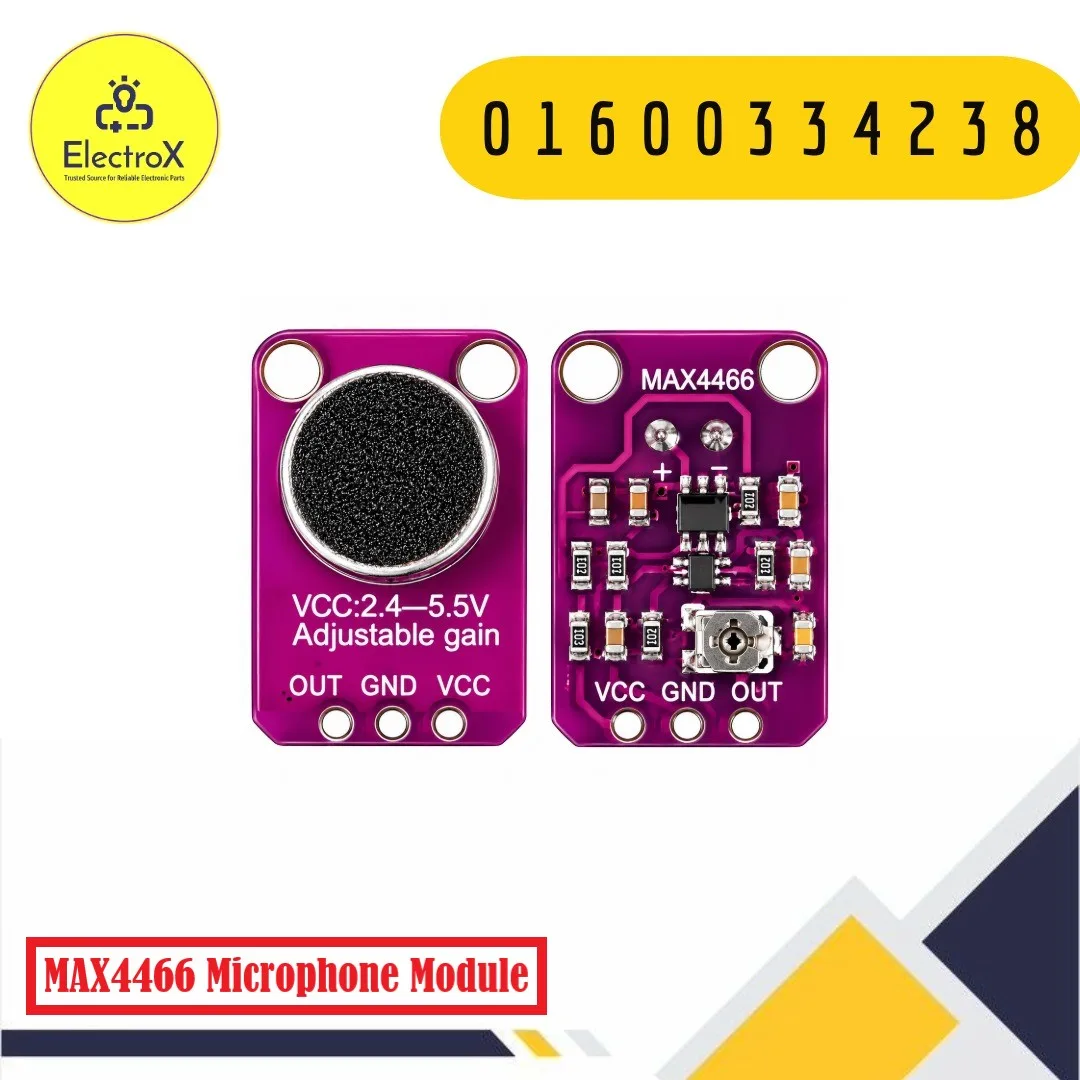
MAX4466 Electret Microphone Amplifier Module
৳ 220
- Amplifier IC: MAX4466 low-noise microphone preamplifier
- Microphone: Electret condenser microphone
- Operating Voltage: Typically 2.4V–5.5V
- Adjustable Gain: Common breakout versions offer approximately 25x–125x
- Output: Analogue audio signal with DC bias, typically around VCC/2
MAX4466 Electret Microphone Amplifier Module Price in Bangladesh
The MAX4466 Electret Microphone Amplifier Module is a compact audio sensing and amplification board designed to capture sound and provide an amplified analogue signal for electronic circuits and microcontroller-based projects. It combines an electret condenser microphone with the MAX4466 operational amplifier, which is specifically designed for microphone preamplifier applications.
The module is useful when a microcontroller needs to detect or analyse sound signals. A microphone produces a relatively weak electrical signal, which may not be suitable for direct processing by many electronic circuits. The MAX4466 amplifies this signal, making it easier for a connected Arduino, ESP32, Raspberry Pi-compatible analogue input interface, or other audio-processing circuit to work with it.
One of the most useful features of this module is its adjustable gain. A small trimmer potentiometer on common breakout-board versions allows users to change the amplification level according to the sound source and application. This makes it suitable for both relatively quiet sounds and louder audio environments, although the gain must be adjusted carefully to prevent signal clipping.
The module is commonly used in sound-reactive LED projects, voice detection systems, audio recording experiments, sound-level monitoring prototypes, voice-controlled electronics, and frequency analysis projects.
Unlike a digital sound sensor that provides only a HIGH or LOW signal when sound crosses a threshold, the MAX4466 provides an analogue waveform. This allows a microcontroller or audio-processing circuit to examine changes in the signal rather than simply detecting the presence of sound.
For electronics students, engineers, robotics developers, and hobbyists, the MAX4466 is a practical component for learning about microphones, analogue signal conditioning, and audio processing.
What Is the MAX4466 Microphone Amplifier?
The MAX4466 is a low-noise operational amplifier designed for microphone preamplifier applications. It is manufactured by Maxim Integrated, now part of Analog Devices.
The IC is designed to amplify small microphone signals while maintaining useful noise performance. It operates from a relatively low supply voltage and provides a rail-to-rail output stage.
In a typical breakout module, an electret microphone captures sound waves and converts them into small electrical signals. The MAX4466 amplifies these signals and provides an analogue output that can be connected to a suitable input device.
The amplifier module is therefore useful as an interface between an electret microphone and a microcontroller or audio-processing circuit.
Key Features
1. Built-In Electret Microphone
The module includes an electret microphone capsule on common breakout-board versions. This microphone converts sound pressure variations into corresponding electrical signals.
It can capture speech, music, environmental sounds, and other audible signals within the microphone’s operating range.
2. MAX4466 Low-Noise Amplifier
The MAX4466 is optimised for microphone preamplifier applications. Its low-noise design and strong power-supply rejection characteristics make it suitable for amplifying relatively weak microphone signals.
This helps produce a more usable audio waveform for subsequent processing.
3. Adjustable Amplification Gain
Many MAX4466 breakout modules include a small trimmer potentiometer for adjusting the amplifier gain.
Common implementations provide an adjustable gain range of approximately 25x to 125x. Lower gain is useful for louder sound sources, while higher gain can help capture quieter signals.
The actual range depends on the breakout-board circuit.
4. Analogue Audio Output
The module provides an analogue output that follows the captured sound waveform. A microcontroller with an ADC can sample this signal for sound analysis, waveform monitoring, or audio-reactive control.
The output is not simply a digital sound-detection signal.
5. Wide Audio Frequency Response
A commonly documented MAX4466 breakout implementation supports an approximate frequency response of 20Hz to 20kHz. This covers much of the conventional audible frequency range.
Actual response depends on the microphone capsule, amplifier circuit, gain setting, and board design.
6. Low-Voltage Operation
The module can operate from a low-voltage DC supply. Common breakout designs support approximately 2.4V–5.5V, making them suitable for many embedded electronics platforms.
The exact permissible voltage should be checked against the board’s documentation.
7. Compact Breakout Design
Its compact PCB layout makes it convenient to integrate into breadboard experiments, robotics systems, portable electronics, and educational projects.
8. Useful for Audio Signal Processing
Because the output is an analogue waveform, developers can apply signal-processing techniques such as amplitude measurement, filtering, sampling, and Fast Fourier Transform (FFT) analysis.
This makes the module useful for projects involving sound visualisation and frequency-responsive control.
Technical Specifications
| Parameter | Specification |
|---|---|
| Product Name | MAX4466 Electret Microphone Amplifier Module |
| Amplifier IC | MAX4466 |
| Amplifier Type | Low-noise operational amplifier |
| Microphone Type | Electret condenser microphone |
| Supply Voltage | Common boards: 2.4V–5.5V |
| Adjustable Gain | Approximately 25x–125x on common designs |
| Frequency Response | Approximately 20Hz–20kHz on documented breakout versions |
| Output Type | Analogue audio signal |
| Output Bias | Typically around VCC/2 |
| Output Swing | Rail-to-rail, supply-dependent |
| Interface | Analogue output |
| Adjustment | Onboard gain trimmer |
| Main Applications | Sound detection, recording, audio analysis |
Note: Gain range, microphone response, connector layout, and PCB dimensions can vary between manufacturers and breakout-board versions.
Working Principle
The MAX4466 microphone amplifier module works by converting sound waves into an electrical signal and amplifying that signal for further processing.
First, the electret microphone detects sound pressure variations in the surrounding environment. These variations cause a small electrical signal to be generated at the microphone output.
This signal is relatively weak, so it is passed to the MAX4466 amplifier circuit. The operational amplifier increases the signal amplitude according to the configured gain.
The amplified waveform then appears at the module’s OUT pin. A connected microcontroller or audio-processing circuit can sample the waveform and analyse its characteristics.
For example, an Arduino can repeatedly read the analogue output using its ADC. The program can calculate changes in signal amplitude to detect sound activity. With suitable sampling and processing, the system can also examine different audio frequencies.
The output normally carries a DC bias close to half the supply voltage. When the environment is quiet, the output may remain near this midpoint, while sound causes the voltage to fluctuate around it.
This bias is important when connecting the module to other audio circuits. The receiving circuit must be designed to accept the signal’s DC offset or use suitable AC coupling.
Pin Configuration
Common MAX4466 breakout boards provide three primary connection pins:
| Pin | Function |
|---|---|
| VCC | Positive DC power supply |
| GND | Ground connection |
| OUT | Amplified analogue audio output |
The exact pin order and PCB markings should be checked on the actual board before wiring.
Connecting with Arduino UNO
A basic connection can be made as follows:
| MAX4466 Module | Arduino UNO |
|---|---|
| VCC | 3.3V |
| GND | GND |
| OUT | A0 |
The 3.3V supply is often a convenient choice for reducing supply-related noise, provided the board supports it.
The Arduino can read the analogue signal through A0 and process the sampled values. Because the output is biased around the midpoint of the supply, the program should measure signal variation around the resting value rather than assuming that silence always produces zero.
Connecting with ESP32
| MAX4466 Module | ESP32 |
|---|---|
| VCC | 3.3V |
| GND | GND |
| OUT | Suitable ADC input |
Make sure the output voltage stays within the ESP32 ADC pin’s permitted input range. Use an appropriate ADC configuration and sampling method for the intended audio-processing task.
Applications
1. Sound Detection Systems
The module can be used to detect sound activity in a room, laboratory, or electronic device. A microcontroller can monitor the signal amplitude and trigger an action when sound exceeds a programmed threshold.
2. Voice-Activated Electronics
Developers can build experimental voice-activated systems using the amplified microphone signal. Basic projects can respond to sound patterns or changes in audio amplitude.
However, recognising spoken words requires additional signal processing and, in most cases, speech-recognition software.
3. Audio-Reactive LED Projects
The MAX4466 is useful for LED systems that respond to music or surrounding sounds. A microcontroller can analyse the audio signal and adjust LED brightness, colour, or animation speed.
4. Sound Level Monitoring
The module can be used in educational sound-monitoring prototypes. A microcontroller can calculate signal amplitude and display relative sound activity.
Accurate sound-pressure-level measurement in decibels requires calibration and a suitable measurement method; raw ADC readings are not automatically calibrated dB values.
5. Frequency Analysis
The amplified waveform can be sampled and processed using FFT techniques. This allows developers to examine the frequency components of music, speech, or environmental sound.
6. Audio Recording Experiments
The module can provide an amplified analogue signal to a suitable ADC or audio-recording circuit. Sampling rate, ADC resolution, signal conditioning, and storage capacity determine the recording quality.
7. Robotics and Interactive Projects
Robots can use microphone signals to respond to sound events, claps, or environmental audio. The module can support interactive demonstrations and sound-responsive automation.
8. Educational Electronics Laboratories
Students can explore microphone operation, analogue amplification, ADC sampling, signal noise, frequency response, and digital audio processing.
Advantages
- Combines an electret microphone and amplifier on a compact board.
- Adjustable gain supports different sound environments.
- Provides an analogue waveform rather than only a digital trigger.
- Suitable for Arduino and ESP32 audio experiments.
- Low-voltage operation on compatible breakout versions.
- Useful for FFT and audio-reactive applications.
- Supports sound monitoring and educational signal-processing projects.
- Simple three-wire connection on common module versions.
Limitations and Important Considerations
- The module is a microphone preamplifier, not a speaker power amplifier.
- Its analogue output cannot directly drive ordinary speakers.
- High gain can amplify background noise and cause signal clipping.
- Supply noise and poor grounding can affect audio quality.
- Microphone sensitivity and frequency response vary with the capsule used.
- The output contains a DC bias, commonly around VCC/2.
- Raw microphone readings do not provide calibrated sound-pressure levels.
- Speech recognition requires additional processing beyond basic amplification.
Installation and Usage Tips
- Identify the VCC, GND, and OUT pins on the module.
- Connect the module to a suitable low-noise DC supply.
- Connect GND to the microcontroller ground.
- Connect OUT to a compatible analogue input.
- Start with a low or moderate gain setting.
- Run a basic ADC sampling program to observe the output.
- Gradually adjust the gain until the signal is suitable for the application.
- Keep microphone wiring away from switching regulators and noisy power circuits.
- Use a stable power supply and proper grounding to reduce interference.
- Avoid exposing the microphone to excessive sound pressure or physical damage.
For FFT-based applications, choose an appropriate sampling frequency and collect samples at consistent intervals. A suitable audio-processing algorithm is necessary to extract meaningful frequency information.
Why Choose the MAX4466 Electret Microphone Amplifier Module?
The MAX4466 is a practical solution for projects that need an amplified microphone signal without designing a complete microphone preamplifier circuit from scratch.
Its combination of an electret microphone, low-noise amplifier, adjustable gain, and analogue output makes it useful for audio experiments and embedded electronics applications.
Whether you are building a sound-reactive LED display, a voice-controlled prototype, a sound-monitoring device, or an FFT-based audio visualiser, this module provides a convenient starting point.
Why Buy from ElectroXBD?
ElectroXBD supplies electronic components, sensors, robotics accessories, development boards, and project materials for students, engineers, researchers, technicians, and electronics enthusiasts in Bangladesh.
Whether you are developing an Arduino project, building a robotics prototype, or experimenting with audio signal processing, ElectroXBD aims to provide useful electronic components for your work.
Business: ElectroXBD
Website: https://electroxbd.com
Contact / WhatsApp: 01600334238
Email: electroxbd@gmail.com
Shop Address: H#1/1, Opposite of RH Chhatrabash, Vodra-Talaimari Road, Rajshahi, Bangladesh.
Frequently Asked Questions (FAQ)
1. What is the MAX4466 Electret Microphone Amplifier Module used for?
It is used to capture sound through an electret microphone and amplify the resulting electrical signal for microcontrollers, audio processing, sound monitoring, and audio-reactive projects.
2. Is the MAX4466 compatible with Arduino UNO?
Yes. Connect VCC, GND, and OUT to the appropriate Arduino pins. The analogue output can be read using the Arduino ADC.
3. Can I use the MAX4466 with ESP32?
Yes. It can connect to a suitable ESP32 ADC input. Ensure that the output voltage remains within the ADC pin’s permitted input range.
4. What is the operating voltage of the MAX4466 module?
Common breakout-board versions support approximately 2.4V–5.5V. Always verify the voltage requirements of the specific board.
5. What is the purpose of the onboard potentiometer?
The potentiometer adjusts the microphone amplifier’s gain. It allows users to increase or decrease the amplification according to the sound level and project requirements.
6. Does the MAX4466 provide analogue or digital output?
It provides an analogue audio waveform. A microcontroller can sample this signal through an ADC for sound detection and audio analysis.
7. Can the MAX4466 directly drive a speaker?
No. It is a microphone preamplifier, not a speaker power amplifier. A separate audio power amplifier is required to drive a speaker.
8. Can this module detect voice and music?
Yes. It can capture voice and music as analogue audio signals. Additional software is required for voice recognition, frequency analysis, or music classification.
9. Can I use the MAX4466 for an FFT audio visualiser?
Yes. Its analogue output can be sampled by a microcontroller and processed using an FFT algorithm to identify frequency components for audio visualisation.
10. Where can I buy the MAX4466 Electret Microphone Amplifier Module in Bangladesh?
You can buy the MAX4466 Electret Microphone Amplifier Module from ElectroXBD, a trusted electronics components supplier in Bangladesh.
Common Questions:
Q: What is the price of MAX4466 Electret Microphone Amplifier Module in Bangladesh?
A: The latest price of MAX4466 Electret Microphone Amplifier Module in Bangladesh is 220 BDT.
Q: Where to buy MAX4466 Electret Microphone Amplifier Module in Bangladesh?
A: You can buy the MAX4466 Electret Microphone Amplifier Module at the best price from ElectroXBD in Bangladesh.
FAQs
Related products
-
MP3 Lossless Decoder Module
Original price was: ৳ 300.৳ 250Current price is: ৳ 250.Add to cart- MP3 Lossless Decoder Audio Formats: Supports MP3, WAV, WMA, FLAC, APE.
- Output Interface: Stereo 3.5mm audio jack.
- Power Supply: 5V DC.
- Storage: MicroSD card, USB drive support.
- Control Interface: Buttons for play, pause, next, and previous.
-
1 Chanel Relay Module 5V
Original price was: ৳ 100.৳ 60Current price is: ৳ 60.Add to cart- Operating Voltage: 5V DC.
- Relay Output: Supports up to 10A at 250V AC or 10A at 30V DC.
- Trigger Current: 15-20mA, suitable for microcontroller GPIO pins.
- Optocoupler Isolation: Provides electrical isolation between control and relay circuits.
- Indicator LED: Lights up when the relay is activated, indicating operational status.
-
XH-M601 Battery Charging Control Module
Original price was: ৳ 250.৳ 200Current price is: ৳ 200.Add to cart- Input Voltage: 10V-30V DC.
- Output Voltage: Adjustable, typically 12V, 24V, etc.
- Charging Current: Up to 20A (adjustable based on battery requirements).
- Protection Features: Overcharge, over-discharge, and reverse polarity protection.
- Battery Types Supported: Lead-acid and lithium batteries.