DC 12V NE555 Timer Relay Delay Module
৳ 250
- Operating Voltage: 12V DC
- Timer IC: NE555 precision timer
- Adjustable Delay: Approximately 0–10 seconds
- Relay Output: Single-channel electromechanical relay
- Relay Contact Rating: Commonly rated up to 10A at 250V AC or 10A at 30V DC
5 in stock
DC 12V NE555 Timer Relay Delay Module Price in Bangladesh
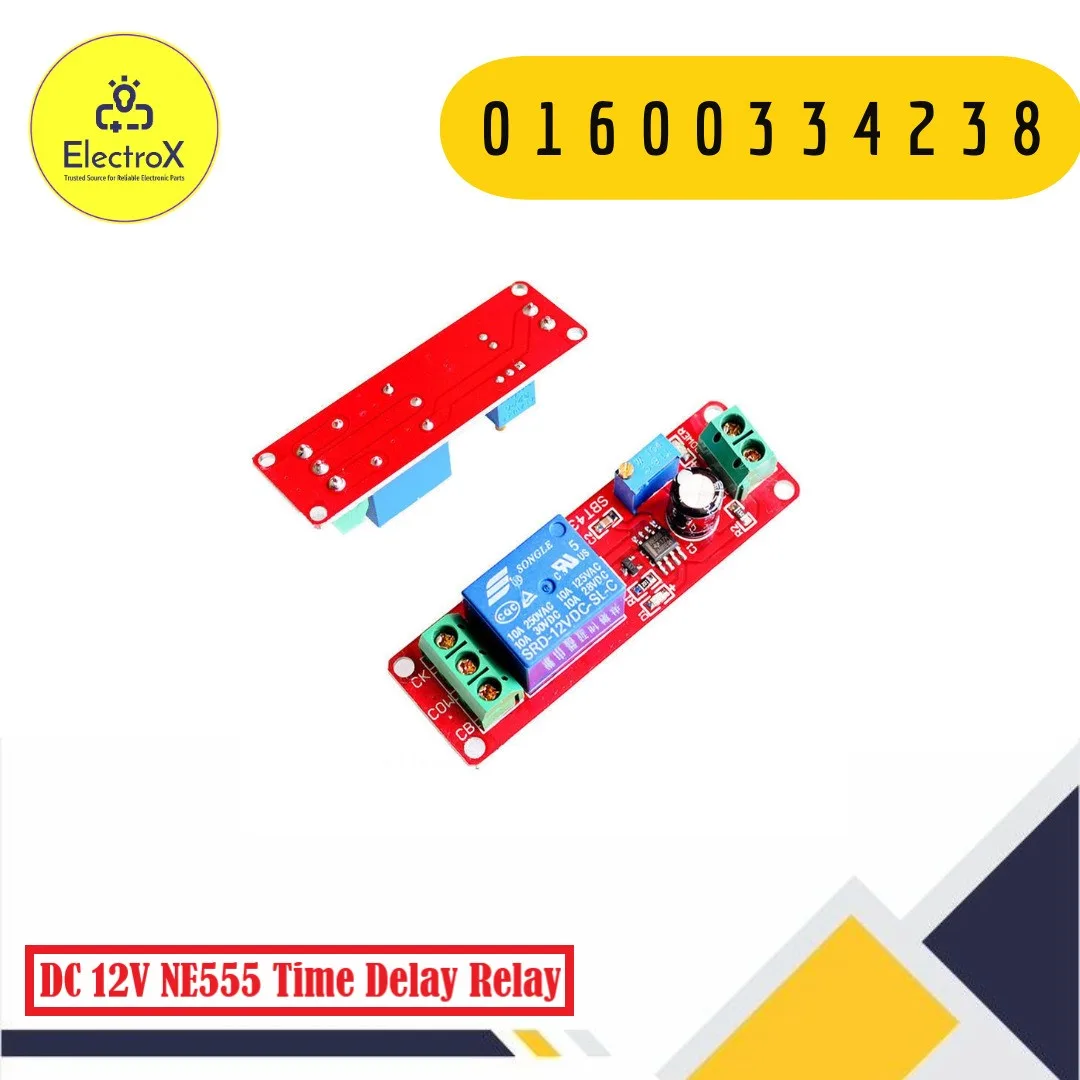
The DC 12V NE555 Timer Relay Delay Module is a compact electronic control board designed to introduce a time delay before switching a connected circuit. It uses the popular NE555 timer integrated circuit to control the timing operation and an onboard relay to switch an external electrical circuit.
This module is commonly available in the HW-010-style configuration, which offers an adjustable delay of approximately 0–10 seconds. A small onboard potentiometer allows the timing interval to be adjusted according to the requirements of a project. When the module receives its 12V DC supply, the timing circuit begins its operation and activates the relay after the selected delay.
The relay provides three commonly available contact terminals: COM (Common), NO (Normally Open), and NC (Normally Closed). These contacts offer flexibility when integrating the module into a compatible control circuit. The actual switching behaviour depends on the relay configuration and the particular board design.
Unlike programmable timer systems, this module does not normally require Arduino code or firmware. Its timing function is implemented using the NE555 timer circuit and associated electronic components. This makes it useful for basic automation projects, educational experiments, and applications that require a short power-on delay.
The module is designed for users who need a straightforward timing solution without building an entire timer circuit from individual components. Before installation, verify the module’s delay range, relay contact ratings, terminal labels, and operating requirements because similar-looking versions may have different specifications.
What Is an NE555 Timer Relay Module?
An NE555 timer relay module combines a timer circuit with an electrically controlled switching relay. The NE555 is a widely used integrated circuit capable of generating timing intervals and controlling output states through an external resistor-capacitor network.
In a delay relay module, the timer circuit determines when the relay should activate. The relay then switches the connected circuit through its contacts. This arrangement separates the timing function from the external circuit being controlled.
The module is particularly useful when a device needs to activate after a short waiting period rather than immediately after the timer circuit receives power.
The onboard potentiometer provides a convenient way to adjust the delay. Depending on the module’s circuit design, changing the resistance changes the capacitor charging time and therefore the timing interval.
Key Features
1. NE555-Based Timing Circuit
The module uses the NE555 timer IC to generate the timing interval. This widely used timer design is suitable for basic delay-control applications and electronics learning.
2. Adjustable Delay Interval
The common HW-010 version offers an adjustable delay of approximately 0–10 seconds. The onboard potentiometer allows users to increase or decrease the interval within the circuit’s available range.
3. 12V DC Operating Supply
The module is designed to operate from a nominal 12V DC power supply. A suitable, regulated supply helps the timing circuit operate within its intended voltage range.
4. Single-Channel Relay Output
An onboard electromechanical relay provides one switching channel. Its COM, NO, and NC contacts allow different switching arrangements, depending on the application.
5. Compact Circuit Board
The compact PCB makes the module convenient for control panels, prototypes, educational circuits, and small automation projects.
6. Simple Timing Adjustment
The timing interval can be adjusted using the onboard potentiometer instead of changing software settings. This makes the module convenient for projects that need basic adjustable timing.
7. No Microcontroller Programming Required
The timer’s basic operation is handled by the NE555 circuit. An Arduino or another microcontroller is not normally required for the module’s standalone timing function.
8. Visual Status Indication
Some versions include a power indicator LED and a relay-status LED. Indicator availability and behaviour depend on the specific PCB version.
Technical Specifications
| Parameter | Specification |
|---|---|
| Product Name | DC 12V NE555 Timer Relay Delay Module |
| Common Model | HW-010-style module |
| Timer IC | NE555 |
| Supply Voltage | 12V DC |
| Timer Function | Power-on delay |
| Adjustable Delay Range | Approximately 0–10 seconds |
| Adjustment Method | Onboard potentiometer |
| Relay Channels | 1 |
| Relay Type | Electromechanical relay |
| Relay Contacts | COM, NO, NC |
| Maximum Contact Rating | Commonly up to 10A at 250V AC or 30V DC, subject to the installed relay and board ratings |
| Indicators | Power and relay status LEDs on some versions |
| Controller Requirement | No external microcontroller required for standalone timing |
| Main Applications | Delayed switching, automation experiments, and electronic control projects |
Technical specification note: The 0–10 second range and 10A contact rating are typical of this module family, not guaranteed for every version. Confirm the exact board revision, installed relay markings, and manufacturer’s specifications before publishing these ratings as definitive product specifications.
Working Principle
The module works by combining an NE555 timer circuit with an electromechanical relay. When the 12V DC supply is applied, the timing components determine how long the circuit waits before activating the relay.
The timing interval depends on the arrangement and values of the resistor and capacitor connected to the timer IC. In a typical timing circuit, the capacitor charges through a resistance. When the capacitor voltage reaches the timer’s internal switching threshold, the timer changes its output state and drives the relay-control stage.
The relay then changes the state of its contacts. The NO contact is open when the relay is inactive and closes when the relay activates. The NC contact behaves in the opposite way, while COM serves as the common connection.
The exact timing sequence depends on the module’s circuit design. A common power-on-delay version activates the relay after the selected waiting period and keeps it activated while the supply remains present. Other related modules may have different triggering or reset behaviour.
Because the timing circuit uses analog components, the actual delay can vary slightly with component tolerances, supply conditions, and adjustment position. The potentiometer provides practical adjustment, but the module should not be treated as a precision industrial timer unless its specifications confirm that level of accuracy.
Applications
Delayed Power Switching
The module can introduce a short delay before a compatible circuit is switched on. This is useful in projects where immediate activation is not desired.
Electronics Prototyping
Students and electronics hobbyists can use the board to explore timer circuits, relay switching, and basic automation concepts.
Sequential Startup Projects
In a suitable control arrangement, a delay relay can help stagger the startup of separate devices rather than activating them simultaneously. The overall system must be designed for the connected equipment.
DC Control Circuits
The relay contacts can switch compatible DC loads when voltage and current remain within the verified contact ratings.
Arduino and Microcontroller Projects
The module can provide an external timing function alongside an Arduino or another controller. The controller is optional for the module’s standalone timing operation.
Educational Demonstrations
The board can demonstrate how resistor-capacitor timing networks, timer ICs, and relay contacts work together in an electronic control system.
DIY Automation Experiments
It can serve as a timing component in suitable prototypes and small control projects that require a short, adjustable delay.
Advantages
- Uses the widely available NE555 timer IC.
- Provides an adjustable short delay.
- Operates from a 12V DC supply.
- Includes an onboard relay for circuit switching.
- Offers COM, NO, and NC contacts on typical versions.
- Does not normally require microcontroller programming.
- Useful for electronics education and prototyping.
- Combines the timing circuit and relay switching stage on one PCB.
Limitations
The common 0–10 second range is intended for short timing intervals. Applications requiring minutes, hours, highly precise timing, or advanced timing sequences may need a different controller.
The NE555 circuit’s timing accuracy depends on component tolerances and operating conditions. This module should not be assumed to provide precision industrial timing.
The relay’s advertised current rating does not mean that every type of load can be switched safely at that current. Motor startup current, inductive loads, switching frequency, contact life, and the PCB’s design all affect the suitable operating limit.
The module is not necessarily protected against incorrect polarity, supply transients, or every type of electrical fault. Protection features depend on the actual board revision.
Installation and Usage Tips
- Use a suitable 12V DC supply that matches the module’s requirements.
- Confirm the input polarity and terminal labels before connecting power.
- Identify COM, NO, and NC from the markings on the actual PCB.
- Verify the load voltage and current against the installed relay’s contact ratings.
- Keep the timer board within its intended operating environment.
- Avoid exceeding the relay’s ratings, particularly with motors and other inductive loads.
- Disconnect power before changing wiring or making adjustments.
- Treat relay contacts connected to mains electricity as hazardous; mains-powered wiring should be handled by a qualified adult or electrician using appropriate protection.
- Test the timing behaviour with a suitable low-voltage circuit before integrating the module into a larger system.
Why Choose the DC 12V NE555 Timer Relay Delay Module?
This timer relay module is a practical choice for projects that need a short, adjustable delay without a programmable controller. Its NE555-based timing circuit, onboard potentiometer, and single relay output combine essential timing and switching functions in a compact board.
It can be used for educational experiments, prototypes, and compatible automation control circuits. Selecting the correct version and respecting the relay’s actual contact ratings are essential for reliable performance.
Why Buy from ElectroXBD?
ElectroXBD supplies electronic components, modules, sensors, and accessories for students, hobbyists, makers, laboratories, and engineering projects in Bangladesh.
Whether you are building an electronics prototype, learning about timer circuits, or assembling a control system, ElectroXBD helps you source components for your project requirements.
Business Address: H#1/1, Opposite of RH Chhatrabash, Vodra-Talaimari Road, Rajshahi, Bangladesh.
Website: electroxbd.com
Contact / WhatsApp: 01600334238
Email: electroxbd@gmail.com
Frequently Asked Questions (FAQ)
1. What is a DC 12V NE555 Timer Relay Delay Module?
It is an electronic timing board that uses an NE555 timer IC to introduce a delay before activating an onboard relay.
2. What is the delay range of this module?
The common HW-010-style version provides an adjustable delay of approximately 0–10 seconds. Confirm the range printed on the actual product listing or supplied board.
3. Does this module require Arduino programming?
No. Its basic timing function operates through the NE555 circuit and does not normally require an Arduino or another microcontroller.
4. What is the function of the onboard potentiometer?
The potentiometer adjusts the timing interval by changing the resistance in the timing circuit.
5. What are COM, NO, and NC?
COM is the common relay terminal. NO means Normally Open, and NC means Normally Closed. Their contact states change when the relay activates or deactivates.
6. Can this module operate from a 5V supply?
The module described here is designed for 12V DC operation. A 5V supply should not be used unless the exact board specification explicitly supports it.
7. What is the maximum relay load?
Common versions use a relay rated up to 10A at 250V AC or 30V DC, but the actual installed relay and board specifications must be checked before use.
8. Can this module control a motor?
It may be suitable for a compatible motor-control application if the motor’s operating and startup currents are within the relay’s verified limits. Additional circuit protection may be required.
9. Does the relay remain activated after the delay?
On a common power-on-delay version, the relay activates after the selected interval and remains activated while the module is powered. Behaviour can differ between board designs.
10. Where can I buy the DC 12V NE555 Timer Relay Delay Module in Bangladesh?
You can buy the DC 12V NE555 Timer Relay Delay Module from ElectroXBD, a trusted electronics components supplier in Bangladesh. Visit electroxbd.com or contact 01600334238 for product availability.
Common Questions:
Q: What is the price of DC 12V NE555 Time Delay Relay Adjustable Module in Bangladesh?
A: The latest price of DC 12V NE555 Time Delay Relay Adjustable Module in Bangladesh is 250 BDT.
Q: Where to buy DC 12V NE555 Time Delay Relay Adjustable Module in Bangladesh?
A: You can buy the DC 12V NE555 Time Delay Relay Adjustable Module at the best price from ElectroXBD in Bangladesh.
FAQs
Related products
-
Servo Motor Tester Module
৳ 150Add to cart- Input Voltage: Servo Motor Tester perates on 4.8V to 6V DC.
- Testing Modes: Supports manual, neutral, and automatic sweep modes.
- Control Knob: Equipped with a rotary knob for manual testing.
- Output Interface: Includes three output connectors to test up to three servos simultaneously.
- Compact Design: Lightweight and portable for easy integration into various projects.
-
AS10 Photocell Light Dependent Switch
Original price was: ৳ 220.৳ 190Current price is: ৳ 190.Add to cart- Operating Voltage: AC 220V–240V
- Sensor Type: Photocell (Light Dependent)
- Control Mode: Automatic Day/Night Switching
- Installation: Outdoor Wall/Pole Mount
- Application: Automatic Lighting Control
-
4 Channel Relay Module
Original price was: ৳ 299.৳ 250Current price is: ৳ 250.Add to cart- Operating Voltage: 5V DC for reliable performance.
- Relay Capacity: Supports up to 250V AC/10A or 30V DC/10A.
- Trigger Type: Low-level trigger for easy microcontroller integration.
- Indicator LEDs: Built-in status LEDs for each relay channel.
- Compatibility: Works with Arduino, Raspberry Pi, and other microcontrollers.