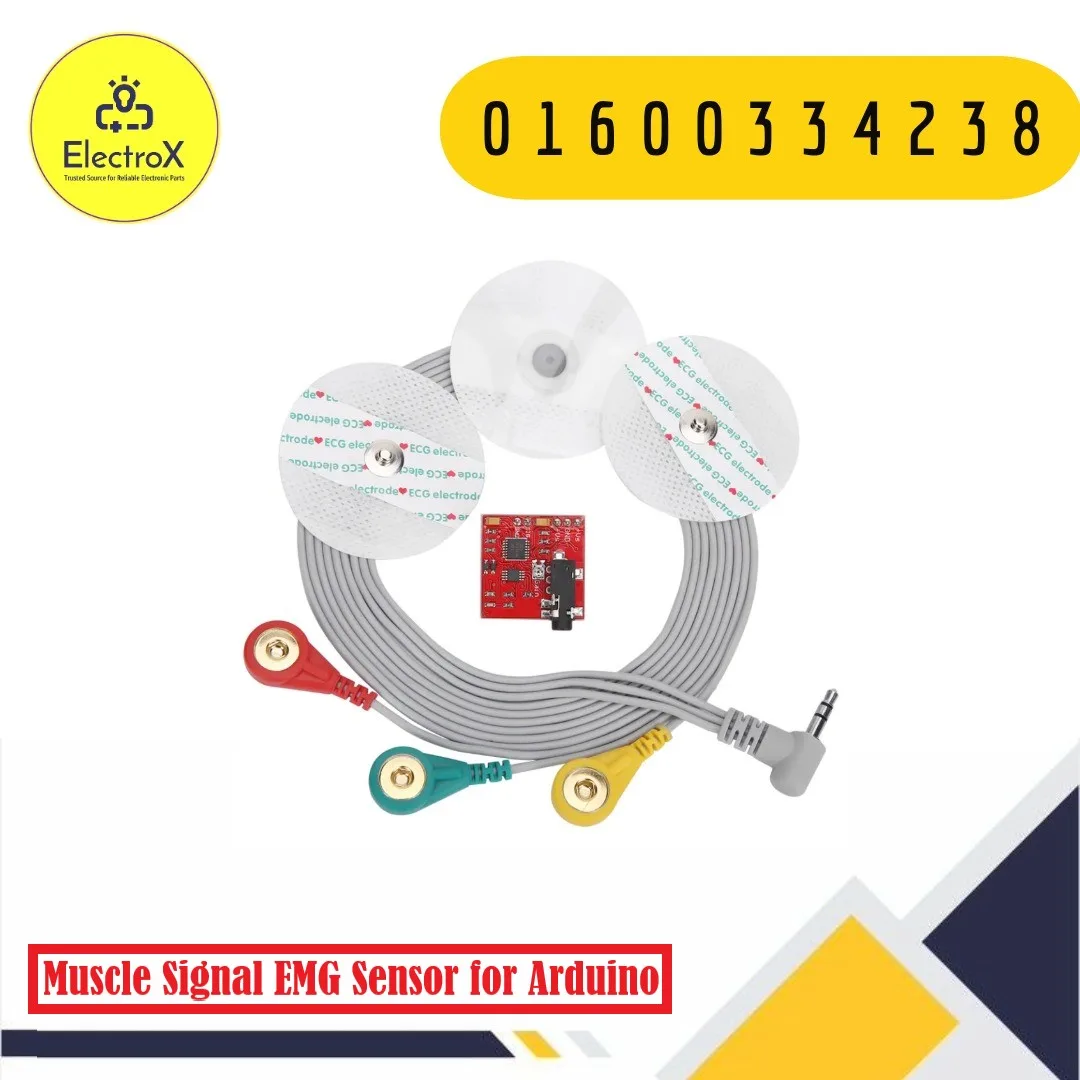
Muscle Signal EMG Sensor for Arduino V1.2
৳ 1,850
- Product Type: Electromyography (EMG) sensor module
- Version: V1.2
- Signal: Surface muscle electrical activity
- Output: Analog EMG signal
- Application: Arduino, biomedical electronics and signal-processing projects
1 in stock
Muscle Signal EMG Sensor for Arduino Price in Bangladesh
The Muscle Signal EMG Sensor for Arduino V1.2 is an electronic module designed to acquire electrical signals associated with muscle activity. EMG, or electromyography, is a technique used to detect and study the electrical activity produced by muscles.
This sensor module provides a convenient platform for students, electronics hobbyists, biomedical engineering learners, researchers, and Arduino developers who want to experiment with biological signal acquisition and processing.
Unlike conventional sensors that measure temperature, light, pressure, or distance, an EMG sensor works with very small electrical signals generated by biological tissue. The module conditions the acquired signal and provides an output suitable for connection to a compatible analog input or data-acquisition system.
The V1.2 version is particularly useful for educational projects involving Arduino, embedded systems, biomedical instrumentation, robotics interfaces, and physiological signal processing.
Because biological signals are sensitive to electrode placement, movement, electrical interference, and environmental conditions, the quality of the resulting signal depends on both the sensor and the overall experimental setup.
What is EMG?
Electromyography (EMG) is a technique used to record electrical activity associated with skeletal muscle activation.
When a muscle is activated, electrical signals are generated by motor units within the muscle. Surface EMG systems use electrodes placed on the skin to detect these signals without directly inserting electrodes into the muscle.
An EMG sensor conditions these small signals so they can be observed, analyzed, or processed by an electronic system.
For educational Arduino projects, EMG data can be used to demonstrate concepts such as analog signal acquisition, filtering, amplification, threshold detection, waveform analysis, and basic human-machine interfaces.
Key Features
Muscle Activity Detection
The module is designed to acquire electrical signals associated with muscle activation through suitable surface electrodes.
Analog Signal Output
The conditioned EMG signal can be connected to a compatible analog input for further processing or visualization.
Arduino Compatible
The sensor can be incorporated into Arduino-based projects where an analog signal is sampled and processed by a microcontroller.
Biomedical Electronics Learning
The module provides a practical way to explore biological signal acquisition and basic biomedical instrumentation concepts.
Compact Development Module
Its compact design makes it convenient for prototyping, laboratory demonstrations, and experimental electronics projects.
Signal Processing Experiments
The output can be analyzed using software to explore filtering, sampling, amplitude changes, waveform characteristics, and other signal-processing concepts.
Technical Specifications
- Product Name: Muscle Signal EMG Sensor
- Version: V1.2
- Sensor Type: Surface EMG / electromyography module
- Signal Type: Electrical muscle activity
- Output: Analog signal
- Interface: Analog output
- Controller Compatibility: Arduino and other compatible analog data-acquisition systems
- Electrodes: External surface electrodes
- Application: Muscle activity experiments and biomedical signal processing
- Board Type: Compact electronic sensor module
- Use: Educational, experimental and prototyping applications
Note: Electrical specifications such as supply voltage, gain, bandwidth, output range, connector type, and electrode configuration can vary between EMG module manufacturers and V1.2 board revisions. Please verify the markings and documentation of the supplied version before designing a permanent circuit.
Working Principle
The Muscle Signal EMG Sensor detects small electrical signals associated with muscle activity through surface electrodes.
When the target muscle is activated, electrical potential changes occur within the underlying tissue. Surface electrodes placed appropriately on the skin can detect a portion of these electrical variations.
Because the raw biological signal is very small, an EMG system typically uses amplification and filtering stages to make the signal suitable for electronic measurement. The conditioned signal is then presented as an analog output that can be sampled by a microcontroller or other data-acquisition equipment.
With Arduino, the analog input can periodically sample the EMG output. Software can then display the waveform, calculate signal characteristics, detect changes in muscle activity, or use the signal as an input for an experimental control system.
The quality of an EMG signal depends on electrode placement, skin contact, movement, electrical interference, amplifier characteristics, and signal-processing techniques.
Applications
The Muscle Signal EMG Sensor can be used for:
- Arduino EMG projects
- Biomedical engineering experiments
- Muscle activity detection
- Electromyography demonstrations
- Physiological signal processing
- Human-machine interface experiments
- Robotics control research
- Educational biomedical instrumentation
- Analog signal-processing projects
- Arduino data-acquisition experiments
- Wearable electronics research
- Bio-signal visualization
- Embedded biomedical projects
- University laboratory experiments
- STEM and electronics education
Advantages
- Designed for muscle electrical signal experiments
- Analog output for easy data acquisition
- Suitable for Arduino-based projects
- Useful for biomedical engineering education
- Supports signal-processing experiments
- Compact and convenient for prototyping
- Can demonstrate real-world physiological signal acquisition
- Suitable for research and educational experimentation
Limitations
EMG signals are relatively small and can be affected by electrical noise, motion artifacts, electrode placement, and changes in electrode contact.
The module should therefore be considered a development and educational sensor, rather than a certified clinical diagnostic instrument. Measurements from a hobby or development setup should not be used to diagnose medical conditions.
Different EMG modules can also have different amplification, filtering, supply, connector, and output characteristics. The exact specifications of the supplied V1.2 board should be verified before integration.
Installation / Usage Tips
Use suitable surface electrodes and connect them according to the sensor manufacturer’s documentation. Proper electrode placement is important for obtaining a usable EMG signal.
Keep sensor wiring reasonably organized and minimize unnecessary movement during experiments, as movement can introduce unwanted artifacts into the measured signal.
Connect the module’s analog output to a suitable analog-input system and ensure that the output voltage remains within the input range of the connected microcontroller.
For Arduino experiments, sample the analog output at an appropriate rate and consider basic filtering or signal averaging when analyzing the data.
Because this is a bio-signal measurement system, use electrically safe, battery-powered or appropriately isolated experimental setups and follow the sensor manufacturer’s safety documentation. Do not connect experimental bio-signal equipment directly to unsafe mains-referenced circuitry.
Why Choose Muscle Signal EMG Sensor for Arduino V1.2?
The Muscle Signal EMG Sensor provides an accessible platform for learning how electrical signals generated by muscles can be acquired and processed electronically.
For students and developers working in biomedical engineering, embedded systems, robotics, or signal processing, the module can bridge the gap between theoretical concepts and practical data acquisition.
It can be particularly useful for projects where a physiological signal is used as an experimental input for an Arduino or other microcontroller system.
Why Buy from ElectroXBD?
ElectroXBD is a trusted electronics components supplier in Bangladesh, offering Arduino boards, sensors, biomedical electronics modules, robotics parts, electronic tools, batteries, and project components.
Our shop is located at:
H#1/1, Opposite of RH Chhatrabash, Vodra-Talaimari Road, Rajshahi
Whether you are a student working on a biomedical engineering project, a researcher developing a prototype, or an electronics enthusiast exploring physiological signals, ElectroXBD provides practical components for electronics and embedded-system development.
ElectroXBD – Trusted Source for Reliable Electronic Parts
Frequently Asked Questions (FAQ)
What is an EMG sensor?
An EMG sensor is an electronic device used to detect electrical signals associated with muscle activity. Surface EMG sensors use electrodes placed on the skin to acquire these signals.
What is the Muscle Signal EMG Sensor used for?
It is used for educational and experimental projects involving muscle activity detection, electromyography, biomedical signal processing, Arduino projects, and human-machine interface research.
Can I connect the EMG sensor to Arduino?
Yes. The module provides an analog signal that can be sampled by a compatible Arduino analog input, provided the sensor’s output and supply requirements are suitable for the selected Arduino board.
What type of signal does an EMG sensor detect?
An EMG sensor detects electrical activity associated with muscle activation. The sensor conditions this small biological signal and provides an electronic output suitable for measurement and processing.
Can this sensor be used for robotics projects?
Yes. In experimental systems, EMG signals can be used as an input for studying human-machine interfaces and robotic control concepts.
Is this EMG sensor a medical device?
No. A typical Arduino-compatible EMG development module is intended for education, research, and prototyping. It should not be used as a substitute for certified medical diagnostic equipment.
What affects EMG signal quality?
Electrode placement, electrode contact, muscle position, movement, electrical interference, sensor characteristics, and signal-processing methods can all affect the quality of an EMG measurement.
Where can I buy a Muscle Signal EMG Sensor in Bangladesh?
You can buy the Muscle Signal EMG Sensor for Arduino V1.2 from ElectroXBD, a trusted electronics components supplier in Bangladesh.
Common Questions:
Q: What is the price of Muscle Signal EMG Sensor for Arduino V1.2 in Bangladesh?
A: The latest price of Muscle Signal EMG Sensor for Arduino V1.2 in Bangladesh is 1850 BDT.
Q: Where to buy Muscle Signal EMG Sensor for Arduino V1.2 in Bangladesh?
A: You can buy the Muscle Signal EMG Sensor for Arduino V1.2 at the best price from ElectroXBD in Bangladesh.
Only logged in customers who have purchased this product may leave a review.
FAQs
Related products
-
Capacitive Soil Moisture Sensor
Original price was: ৳ 300.৳ 200Current price is: ৳ 200.Add to cart- Operating Voltage: 3.3V to 5.5V, compatible with most microcontrollers.
- Output Signal: Analog voltage signal, indicating soil moisture levels.
- Corrosion Resistance: Capacitive sensing technology avoids corrosion issues common with resistive sensors.
- Measurement Range: 0% to 100% soil moisture content.
- Dimensions: Approximately 98mm x 23mm, compact and easy to install.
-
TTP223 Touch Sensor Module
৳ 25Add to cart- Operating Voltage: 2.0V to 5.5V DC.
- Touch Detection Range: Detects touch through non-metallic surfaces.
- Output Type: Digital output (high or low).
- Response Time: Typically less than 60 milliseconds.
- Current Consumption: Low power consumption, typically less than 1mA.
-
MQ2 Gas and Smoke Sensor Module
৳ 150Add to cart- Detection Range: 200 to 10000 ppm (Parts Per Million) for combustible gases and smoke.
- Operating Voltage: 5V DC.
- Preheat Time: 20 seconds for optimal performance.
- Sensitivity: Adjustable via onboard potentiometer for different gas concentrations.
- Output: Analog and digital signals for easy integration with microcontrollers like Arduino.



Reviews
There are no reviews yet.