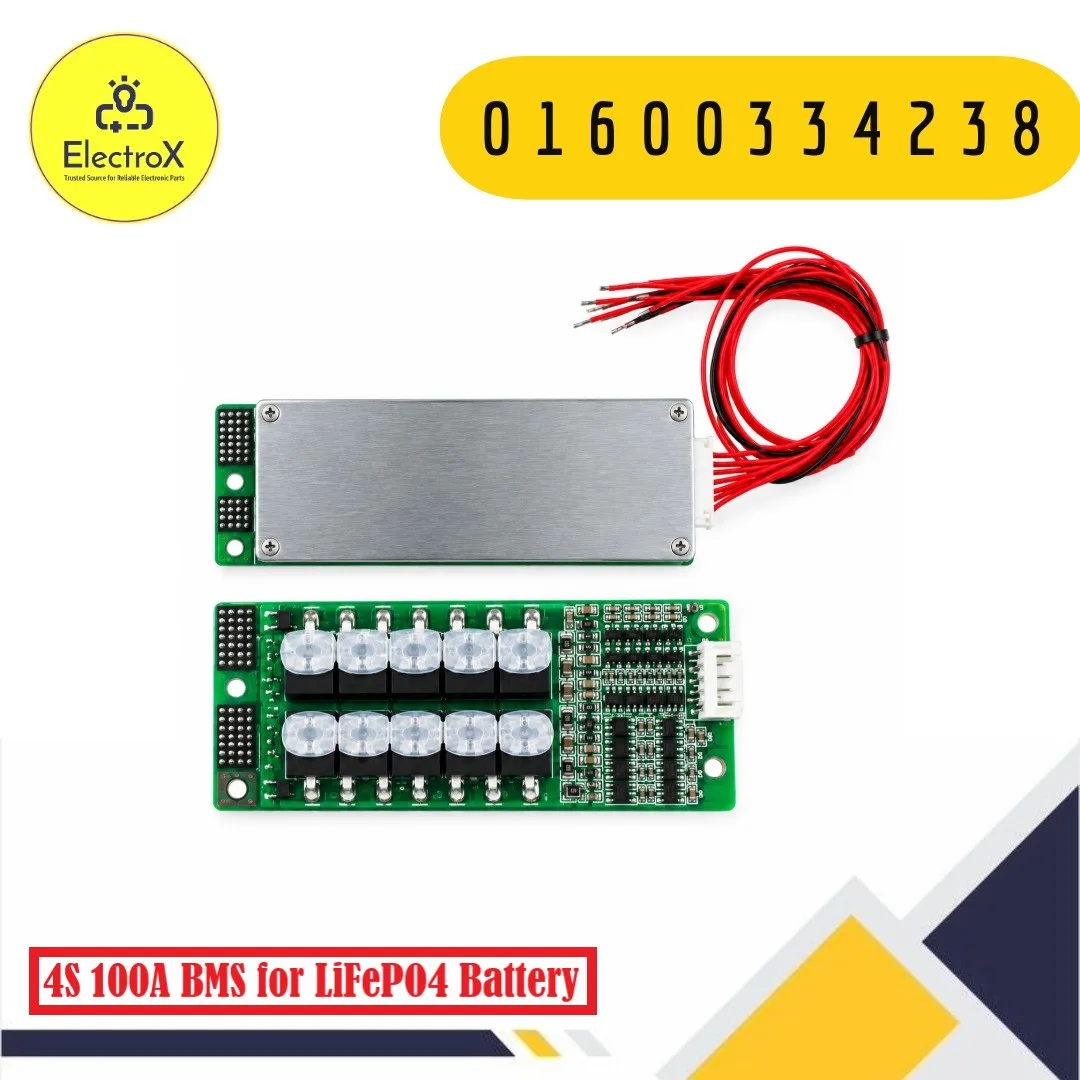
4S 100A BMS for Lithium Iron Phosphate Battery
৳ 650
- Battery Chemistry: LiFePO4 / Lithium Iron Phosphate
- Configuration: 4S
- Nominal Pack Voltage: Approximately 12.8V
- Advertised Current Rating: Up to 100A, depending on board design and operating conditions
- Function: Battery protection and management for 4-cell LiFePO4 packs
3 in stock
4S 100A BMS for Lithium Iron Phosphate Battery
The 4S 100A BMS for Lithium Iron Phosphate Battery is a battery management and protection board designed for rechargeable LiFePO4 battery packs consisting of four cells connected in series. It is suitable for building and protecting 12.8V-class LiFePO4 battery systems used in electronics, backup power, portable equipment, solar applications, and other suitable projects.
LiFePO4 cells require appropriate protection and charging management because the individual cells in a series-connected pack can develop different voltage levels during charging and discharging. A suitable BMS helps monitor the cell group voltages and provides protective functions intended to prevent operation outside specified electrical limits.
The 4S configuration means the board is designed around four LiFePO4 cells or cell groups connected in series. A typical 4S LiFePO4 pack has a nominal voltage of approximately 12.8V, while the fully charged voltage is commonly around 14.6V, depending on the cells and charging specifications.
The advertised 4S 100A BMS rating indicates a high-current BMS category, but the practical continuous current capability depends on the specific board construction, MOSFETs, PCB traces, thermal conditions, enclosure, wiring, and manufacturer specifications. The rating should therefore not be treated as a guarantee of 100A continuous operation under every condition.
What is a LiFePO4 BMS?
A Battery Management System (BMS) is an electronic protection and monitoring system used with rechargeable battery packs. For LiFePO4 batteries, the BMS can monitor individual series cell groups and help protect the battery pack against conditions such as excessive charging, excessive discharge, overcurrent, and short circuit, depending on the particular BMS design.
In a 4S battery configuration, four LiFePO4 cells or cell groups are connected in series. The BMS connects to the individual cell-group points so that it can monitor the voltage of each section of the pack.
A properly selected BMS helps improve battery-pack safety and reliability, but it does not replace a suitable LiFePO4 charger, correctly matched cells, appropriate wiring, fusing, or proper battery-pack construction.
Key Features
- Designed for 4S LiFePO4 battery packs
- Suitable for 12.8V-class LiFePO4 systems
- Advertised high-current capability up to 100A
- Provides battery protection functions
- Monitors series-connected cell groups
- Helps protect against abnormal battery operating conditions
- Suitable for DIY and professional battery-pack projects
- Compact protection-board design
- Useful for rechargeable LiFePO4 battery systems
- Suitable for solar and backup-power projects where properly specified
Technical Specifications
| Specification | Details |
|---|---|
| Product Type | LiFePO4 Battery Management System |
| Battery Chemistry | Lithium Iron Phosphate (LiFePO4) |
| Series Configuration | 4S |
| Nominal Pack Voltage | Approximately 12.8V |
| Fully Charged Voltage | Typically around 14.6V |
| Advertised Current Rating | Up to 100A |
| Battery Type | Rechargeable LiFePO4 |
| Main Function | Battery protection and management |
| Application | 4-cell series LiFePO4 battery packs |
| Installation | Requires correct cell and BMS wiring |
Exact protection thresholds, balancing behavior, MOSFET configuration, dimensions, and continuous-current capability can vary between BMS versions. Always verify the specifications of the actual board before designing a battery pack.
Working Principle
A 4S LiFePO4 BMS monitors the individual voltage levels of the four series-connected cell groups. During charging and discharging, the BMS evaluates the electrical condition of the battery pack and can disconnect the pack when a monitored condition exceeds the protection limits programmed or implemented in the BMS.
Depending on the particular model, protection functions may include overcharge protection, over-discharge protection, overcurrent protection, and short-circuit protection. Some LiFePO4 BMS designs also provide cell balancing functionality.
Cell balancing is important because series-connected cells can gradually develop different states of charge. A balancing circuit can help reduce voltage differences between cells during appropriate charging conditions. However, not every 4S 100A BMS provides the same type or strength of balancing, so this feature should be confirmed for the specific board.
The BMS acts as an important protection layer, but the complete battery system also requires a charger specifically suitable for LiFePO4 chemistry and a correctly assembled battery pack.
Applications
The 4S 100A BMS can be used in suitable applications such as:
- 12.8V LiFePO4 battery packs
- Solar energy storage systems
- Portable power systems
- Backup power equipment
- DIY LiFePO4 battery projects
- Low-voltage energy storage systems
- Robotics and electronics projects
- Portable electronic equipment
- DC power systems
- Custom battery-pack construction
- Suitable marine and recreational power systems
Advantages
A dedicated LiFePO4 BMS simplifies the protection of a 4-cell series battery pack by integrating important monitoring and protection functions onto one board.
The 4S configuration is especially convenient for building approximately 12.8V LiFePO4 battery packs. The high advertised current rating also makes this type of BMS suitable for appropriately designed higher-current applications, provided the actual board, wiring, cells, connectors, and thermal conditions are all capable of supporting the required load.
LiFePO4 chemistry is also widely used for rechargeable energy-storage applications because of its characteristic long cycle life and stable operating characteristics when used within the manufacturer’s specifications.
Limitations
The 100A label should not automatically be interpreted as a guaranteed 100A continuous operating capability. Actual performance depends on the particular BMS board, MOSFETs, PCB construction, temperature, airflow, wiring, connectors, and load conditions.
The BMS cannot compensate for damaged, mismatched, incorrectly connected, or unsuitable cells. It also cannot replace a proper LiFePO4 charging system.
A BMS designed for LiFePO4 chemistry should not be assumed to be suitable for standard lithium-ion, LiPo, or other battery chemistries unless the manufacturer specifically states compatibility.
Installation / Usage Tips
Use only LiFePO4 cells or cell groups that are appropriate for a 4S configuration. The four series groups should be properly matched and assembled before connecting the BMS.
Follow the actual board’s connection diagram carefully. Incorrect cell-sense wiring can damage the BMS or create unsafe battery conditions.
Use a charger specifically designed for 4S LiFePO4 batteries, typically using the appropriate charging voltage for a 4S LiFePO4 pack.
For higher-current battery packs, use appropriately rated wiring, connectors, insulation, and protection components. A suitable fuse can provide an additional layer of protection in a properly designed battery system.
Do not exceed the manufacturer’s specified voltage, current, temperature, or wiring limits. Battery-pack assembly involving high-current LiFePO4 cells should be performed using appropriate safety procedures and equipment.
Why Choose a 4S 100A LiFePO4 BMS?
A 4S LiFePO4 BMS provides a practical protection solution for battery builders working with four-cell-series lithium iron phosphate packs. Its integrated protection functions can reduce the need for separate basic protection circuitry and simplify the design of suitable 12.8V-class battery systems.
The high advertised current category makes this type of board useful for projects where a conventional low-current BMS would not be appropriate, provided the complete battery system is designed for the required current.
Why Buy from ElectroXBD?
ElectroXBD supplies electronic components, battery-related products, Arduino boards, sensors, modules, robotics parts, and other electronics products for students, hobbyists, engineers, project builders, and institutions across Bangladesh.
The 4S 100A BMS for Lithium Iron Phosphate Battery is suitable for customers building properly designed 12.8V-class LiFePO4 battery packs for electronics, backup power, solar, and other compatible applications.
ElectroXBD
Trusted Source for Reliable Electronic Parts
Address: H#1/1, Opposite of RH Chhatrabash, Vodra-Talaimari Road, Rajshahi
WhatsApp/Phone: 01600334238
Website: electroxbd.com
Frequently Asked Questions (FAQ)
1. What is a 4S 100A LiFePO4 BMS?
A 4S 100A LiFePO4 BMS is a battery management and protection board designed for four LiFePO4 cells or cell groups connected in series. The advertised current rating is up to 100A, subject to the board’s actual specifications and operating conditions.
2. What voltage is a 4S LiFePO4 battery?
A typical 4S LiFePO4 battery has a nominal voltage of approximately 12.8V. Its fully charged voltage is commonly around 14.6V, depending on the charging specification of the cells.
3. Can this BMS be used with regular 18650 lithium-ion batteries?
A LiFePO4-specific BMS should not be used with standard lithium-ion cells unless the manufacturer explicitly specifies compatibility. LiFePO4 and conventional lithium-ion batteries have different voltage characteristics and require appropriate protection and charging parameters.
4. Does a 4S 100A BMS provide cell balancing?
Some 4S LiFePO4 BMS boards include balancing functionality, while others may not or may use different balancing methods. The exact balancing specification should be confirmed for the particular board version.
5. Is the 100A rating continuous?
The advertised 100A rating does not by itself guarantee 100A continuous operation in every condition. Actual current capability depends on the BMS design, temperature, cooling, wiring, connectors, and manufacturer’s specifications.
6. What charger should be used with a 4S LiFePO4 battery?
A charger specifically designed for 4S LiFePO4 batteries should be used. The charging voltage and current should match the battery manufacturer’s specifications.
7. Can this BMS be used for a solar battery pack?
Yes, a suitable 4S LiFePO4 BMS can be part of a properly designed 12.8V-class LiFePO4 solar storage system. The charger, solar controller, battery cells, wiring, fuse, and BMS must all be compatible with one another.
8. Where can I buy a 4S 100A LiFePO4 BMS in Bangladesh?
You can buy the 4S 100A BMS for Lithium Iron Phosphate Battery from ElectroXBD, a trusted electronics components supplier in Bangladesh.
Common Questions:
Q: What is the price of 4S 100A BMS for Lithium Iron Phosphate Battery in Bangladesh?
A: The latest price of 4S 100A BMS for Lithium Iron Phosphate Battery in Bangladesh is 650 BDT.
Q: Where to buy 4S 100A BMS for Lithium Iron Phosphate Battery in Bangladesh?
A: You can buy the 4S 100A BMS for Lithium Iron Phosphate Battery at the best price from ElectroXBD in Bangladesh.
Only logged in customers who have purchased this product may leave a review.
FAQs
Related products
-
3S 60A BMS 18650 Lithium Ion Protection Board
Original price was: ৳ 250.৳ 180Current price is: ৳ 180.Add to cart- Battery Compatibility: Designed for 3S 18650 lithium-ion batteries.
- Current Capacity: Supports up to 60A continuous discharge.
- Overcharge Protection: Prevents overcharging to ensure battery safety and longevity.
- Over-discharge Protection: Protects against excessive discharge, preserving battery health.
- Short Circuit Protection: Safeguards batteries and devices from damage due to short circuits.


Reviews
There are no reviews yet.